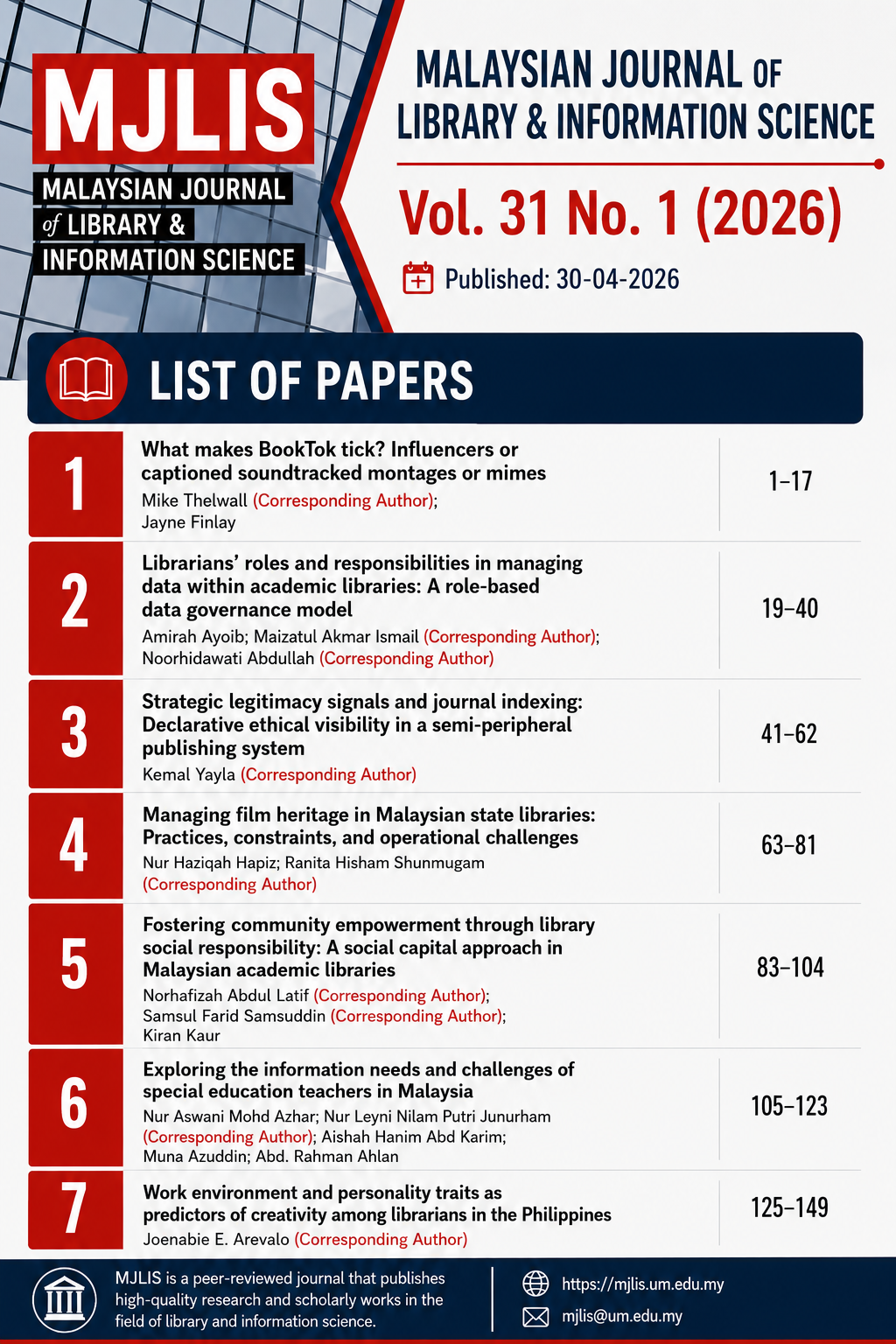
Strategic legitimacy signals and journal indexing: Declarative ethical visibility in a semi-peripheral publishing system
DOI:
https://doi.org/10.22452/mjlis.vol31no1.3Keywords:
Publication ethics, Strategic legitimacy, Institutional isomorphism, Journal indexing, Gatekeeping mechanisms, Research integrityAbstract
This study examines how ethical policy adoption functions as a strategic legitimacy mechanism in semi-peripheral publishing environments, focusing on 2,592 open-access journals hosted on Türkiye's DergiPark platform. Drawing on institutional isomorphism theory and the framework of strategic legitimacy, the research investigates whether declarative ethical visibility, the publicly accessible presence of ethics policy statements, predicts international indexing outcomes after controlling for institutional maturity and platform prominence. Using nested logistic regression models with extensive robustness checks across four classification algorithms and five resampling strategies, the analysis reports three principal findings. First, ethical signalling operates through "threshold logic": journals that reference international governance bodies have 31% higher odds of indexing (OR = 1.31, p < 0.001), yet cumulative policy intensity contributes negligibly, revealing an "Intensity Paradox." Second, a decoupling of declarative signals from operational practice is evident, as observable ethics manifestations (erratum publication) show no association with indexing (OR = 1.04, p > 0.05). Third, while ethical signalling confers a modest advantage (a 6–10 percentage-point increase), it remains structurally subordinate to the maturity (OR = 3.02) and visibility (OR = 4.05) determinants. These patterns are consistent with the view that ethics policies primarily function as symbolic compliance mechanisms that reduce exclusion risk without guaranteeing selection. The findings highlight critical vulnerabilities in gatekeeping regimes that rely on easily mimicked declarative signals, underscoring the need for process-oriented evaluation frameworks that assess operational practice alongside policy presence.
References
Aslan, A. (2019). DergiPark akademik. Acta Medica Alanya, 3(3), 205–206. https://doi.org/10.30565/medalanya.632462.
Astaneh, B., & Masoumi, S. (2018). From paper to practice; indexing systems and ethical standards. Science and Engineering Ethics, 24(2), 647–654. https://doi.org/10.1007/s11948-017-9899-x.
Asubiaro, T., Onaolapo, S., & Mills, D. (2024). Regional disparities in Web of Science and Scopus journal coverage. Scientometrics, 129(3), 1469–1491. https://doi.org/10.1007/s11192-024-04948-x.
Aubert Bonn, N., Godecharle, S., & Dierickx, K. (2017). European universities' guidance on research integrity and misconduct: Accessibility, approaches, and content. Journal of Empirical Research on Human Research Ethics, 12(1), 33–44. https://doi.org/10.1177/1556264616688980.
Bagues, M., Sylos-Labini, M., & Zinovyeva, N. (2019). A walk on the wild side: 'Predatory' journals and information asymmetries in scientific evaluations. Research Policy, 48(2), 462–477. https://doi.org/10.1016/j.respol.2018.04.013.
Berghaeuser, H., Prass, M., & Lindner, R. (2025). Researchers' practice and perception of research ethics and the role of institutional support: Insights from a pan-European researcher survey. Journal of Academic Ethics. 23, 717–738 https://doi.org/10.1007/s10805-024-09590-z.
Breiman, L. (2001). Random forests. Machine Learning, 45(1), 5–32. https://doi.org/10.1023/A:1010933404324.
Broga, M., Mijaljica, G., Waligora, M., Keis, A., & Marusic, A. (2014). Publication ethics in biomedical journals from countries in central and eastern Europe. Science and Engineering Ethics, 20(1), 99–109. https://doi.org/10.1007/s11948-013-9431-x.
Bryce, C., Dowling, M., & Lucey, B. (2020). The journal quality perception gap. Research Policy, 49(5), 103957. https://doi.org/10.1016/j.respol.2020.103957.
Chawla, N. V., Bowyer, K. W., Hall, L. O., & Kegelmeyer, W. P. (2002). SMOTE: Synthetic minority over-sampling technique. Journal of Artificial Intelligence Research, 16, 321–357. https://doi.org/10.1613/jair.953.
Clarivate. (n.d.). Web of Science core collection: Editorial selection process. https://clarivate.com/academia-government/scientific-and-academic-research/research-discovery-and-referencing/web-of-science/web-of-science-core-collection/editorial-selection-process/journal-evaluation-process-selection-criteria/.
Committee on Publication Ethics, Directory of Open Access Journals, Open Access Scholarly Publishing Association, & World Association of Medical Editors. (2022). Principles of transparency and best practice in scholarly publishing. https://doi.org/10.24318/cope.2019.1.12
Connelly, B. L., Certo, S. T., Ireland, R. D., & Reutzel, C. R. (2011). Signaling theory: A review and assessment. Journal of Management, 37(1), 39–67. https://doi.org/10.1177/0149206310388419.
Davis, J., & Goadrich, M. (2006). The relationship between precision-recall and ROC curves. In Proceedings of the 23rd International Conference on Machine Learning (pp. 233–240). ACM. https://doi.org/10.1145/1143844.1143874.
Demeter, M., Pelle, V., Mikulás, G., & Goyanes, M. (2022). Higher quantity, higher quality? Current publication trends of the most productive journal authors on the field of communication studies. Publishing Research Quarterly, 38(3), 445–464. https://doi.org/10.1007/s12109-022-09893-2.
DiMaggio, P. J., & Powell, W. W. (1983). The iron cage revisited: Institutional isomorphism and collective rationality in organizational fields. American Sociological Review, 48(2), 147–160. https://doi.org/10.2307/2095101.
Elsevier. (n.d.). Scopus content policy and selection. https://www.elsevier.com/products/scopus/content/content-policy-and-selection.
Fawcett, T. (2006). An introduction to ROC analysis. Pattern Recognition Letters, 27(8), 861–874. https://doi.org/10.1016/j.patrec.2005.10.010.
Fernandes, M. R., Antonelli Monteiro Queiroz, M. C. C., De Moraes, M. R., Barbosa, M. A., & Lima Sousa, A. L. (2011). Ethical standards adopted by Brazilian journals of medical specialties. Revista da Associação Médica Brasileira (English Edition), 57(3), 264–268. https://doi.org/10.1016/S2255-4823(11)70057-1.
Grudniewicz, A., Moher, D., Cobey, K. D., Bryson, G. L., Cukier, S., Allen, K., Ardern, C., Balcom, L., Barros, T., Berger, M., Ciro, J. B., Cugusi, L., Donaldson, M. R., Egger, M., Graham, I. D., Hodgkinson, M., Khan, K. M., Mabizela, M., Manca, A., … Lalu, M. M. (2019). Predatory journals: No definition, no defence. Nature, 576(7786), 210–212. https://doi.org/10.1038/d41586-019-03759-y.
Gu, X., & Blackmore, K. (2017). Characterisation of academic journals in the digital age. Scientometrics, 110(3), 1333–1350. https://doi.org/10.1007/s11192-016-2219-4.
Hackett, R., & Kelly, S. (2020). Publishing ethics in the era of paper mills. Biology Open, 9(10), bio056556. https://doi.org/10.1242/bio.056556.
He, H., Yang, B., Garcia, E. A., & Li, S. (2008). ADASYN: Adaptive synthetic sampling approach for imbalanced learning. In 2008 IEEE International Joint Conference on Neural Networks (pp. 1322–1328). IEEE. https://doi.org/10.1109/IJCNN.2008.4633969.
Hesselmann, F., Graf, V., Schmidt, M., & Reinhart, M. (2017). The visibility of scientific misconduct: A review of the literature on retracted journal articles. Current Sociology, 65(6), 814–845. https://doi.org/10.1177/0011392116663807.
Huang, D. (2016). Positive correlation between quality and quantity in academic journals. Journal of Informetrics, 10(2), 329–335. https://doi.org/10.1016/j.joi.2016.02.002.
Jiang, X., Li, M., & Zhang, Z. (2025). 'Bridging borders in academia': The motivations, barriers, and strategies of Global North scholars in Chinese higher education research. Higher Education. https://doi.org/10.1007/s10734-025-01558-1.
Le Maux, B., Necker, S., & Rocaboy, Y. (2019). Cheat or perish? A theory of scientific customs. Research Policy, 48(9), 103792. https://doi.org/10.1016/j.respol.2019.05.001.
Long, B. S., & Driscoll, C. (2007). Codes of ethics and the pursuit of organizational legitimacy: Theoretical and empirical contributions. Journal of Business Ethics, 77(2), 173–189. https://doi.org/10.1007/s10551-006-9307-y.
Lovakov, A., & Teixeira Da Silva, J. A. (2025). Scientometric indicators in research evaluation and research misconduct: Analysis of the Russian university excellence initiative. Scientometrics, 130, 1813–1829. https://doi.org/10.1007/s11192-025-05269-3.
Mabe, M., & Amin, M. (2001). Growth dynamics of scholarly and scientific journals. Scientometrics, 51(1), 147–162. https://doi.org/10.1023/A:1010520913124
Margalida, A., & Colomer, M. À. (2015). Mistake index as a surrogate of quality in scientific manuscripts. Proceedings of the National Academy of Sciences, 112(13), E1511. https://doi.org/10.1073/pnas.1500322112.
Marginson, S. (2022). What drives global science? The four competing narratives. Studies in Higher Education, 47(8), 1566–1584. https://doi.org/10.1080/03075079.2021.1942822.
Moussa, S., & Teixeira Da Silva, J. A. (2023). Testing the robustness of COPE's characterization of predatory publishing on a COPE member publisher (Academic and Business Research Institute). Publishing Research Quarterly, 39(4), 337–367. https://doi.org/10.1007/s12109-023-09967-9.
Müller, R., & de Rijcke, S. (2017). Thinking with indicators: Exploring the epistemic impacts of academic performance indicators in the life sciences. Research Evaluation, 26(3), 157–168. https://doi.org/10.1093/reseval/rvx023.
Niles, M. T., Schimanski, L. A., McKiernan, E. C., & Alperin, J. P. (2020). Why we publish where we do: Faculty publishing values and their relationship to review, promotion and tenure expectations. PLOS ONE, 15(3), e0228914. https://doi.org/10.1371/journal.pone.0228914.
Nobes, A., & Harris, S. (2023). Open access in low- and middle-income countries: Attitudes and experiences of researchers. Emerald Open Research, 1(3). https://doi.org/10.1108/EOR-03-2023-0006.
O'Brien, R. M. (2007). A caution regarding rules of thumb for variance inflation factors. Quality & Quantity, 41(5), 673–690. https://doi.org/10.1007/s11135-006-9018-6.
Resnik, D. B., & Dinse, G. E. (2012). Do U.S. research institutions meet or exceed federal mandates for instruction in responsible conduct of research? A national survey. Academic Medicine, 87(9), 1237–1242. https://doi.org/10.1097/ACM.0b013e318260fe5c.
Richardson, R. A. K., Hong, S. S., Byrne, J. A., Stoeger, T., & Amaral, L. A. N. (2025). The entities enabling scientific fraud at scale are large, resilient, and growing rapidly. Proceedings of the National Academy of Sciences, 122(32), e2420092122. https://doi.org/10.1073/pnas.2420092122.
Sharma, K. (2024). Over two decades of scientific misconduct in India: Retraction reasons and journal quality among inter-country and intra-country institutional collaboration. Scientometrics, 129(12), 7735–7757. https://doi.org/10.1007/s11192-024-05192-z.
Suchman, M. C. (1995). Managing legitimacy: Strategic and institutional approaches. The Academy of Management Review, 20(3), 571-610. https://doi.org/10.2307/258788
Siler, K. (2020). Demarcating spectrums of predatory publishing: Economic and institutional sources of academic legitimacy. Journal of the Association for Information Science and Technology, 71(11), 1386–1401. https://doi.org/10.1002/asi.24339.
Tamer, H. Y., Övgün, B., & Yalçintaş, A. (2020). Akademik büyük veri ve bilimsel bilgi üretimi: DergiPark örneği. Ankara Üniversitesi Sosyal Bilimler Dergisi, 11(1), 93. https://doi.org/10.33537/sobild.2020.11.1.10.
Teixeira da Silva, J. A., & Dobránszki, J. (2017). Notices and policies for retractions, expressions of concern, errata and corrigenda: Their importance, content, and context. Science and Engineering Ethics, 23(2), 521–554. https://doi.org/10.1007/s11948-016-9769-y.
Teixeira Da Silva, J. A., & Moussa, S. (2024). The COPE/DOAJ/OASPA/WAME principles of transparency and best practice in scholarly publishing: A critical analysis. Ethics in Progress, 15(1), 130–154. https://doi.org/10.14746/eip.2024.1.7.
Tiokhin, L., Panchanathan, K., Lakens, D., Vazire, S., Morgan, T., & Zollman, K. (2021). Honest signaling in academic publishing. PLOS ONE, 16(2), e0246675. https://doi.org/10.1371/journal.pone.0246675.
TR Dizin. (2022). TR Dizin etik ilkeleri akış şeması. https://trdizin.gov.tr/wp-content/uploads/2022/04/TRDizin_etik_ilkeleri_akis_semasi.pdf.
Tuglular, T., Gurdal, G., Can, G. K., & Ozdemirden, A. S. (2022). Repository landscape in Turkiye and GCRIS: The first national research information system. Procedia Computer Science, 211, 222–229. https://doi.org/10.1016/j.procs.2022.10.195.
Tutuncu, L., & Nasir, H. (2025). Publishing local articles and book chapters: A gamer's shortcut to promotion in a metric-based academic system. Higher Education Policy. https://doi.org/10.1057/s41307-025-00403-5.
Van Dalen, H. P., & Henkens, K. (2005). Signals in science: On the importance of signaling in gaining attention in science. Scientometrics, 64(2), 209–233. https://doi.org/10.1007/s11192-005-0248-5.
Van Dalen, H. P., & Henkens, K. (2012). Intended and unintended consequences of a publish-or-perish culture: A worldwide survey. Journal of the American Society for Information Science and Technology, 63(7), 1282–1293. https://doi.org/10.1002/asi.22636.
Wessels, J. S., & Visagie, R. G. (2017). The eligibility of public administration research for ethics review: A case study of two international peer-reviewed journals. International Review of Administrative Sciences, 83(1_suppl), 156–176. https://doi.org/10.1177/0020852315585949.
Zhang, M., Xu, J., Xu, C., Zheng, Q., Liu, M., Zhang, J., Fu, H., Qi, W., Zhang, J., & Tian, J. (2024). Bibliometric review and mapping analysis of publication ethics research. Ethics & Behavior, 34(6), 397–409. https://doi.org/10.1080/10508422.2024.2306134.
Downloads
Published
Issue
Section
License
It is a condition of publication that manuscripts submitted to the journal have not been published, accepted for publication, nor simultaneously submitted for publication elsewhere. By submitting a manuscript, the author(s) agree that copyright for the article is transferred to the publisher, if and when the manuscript is accepted for publication.