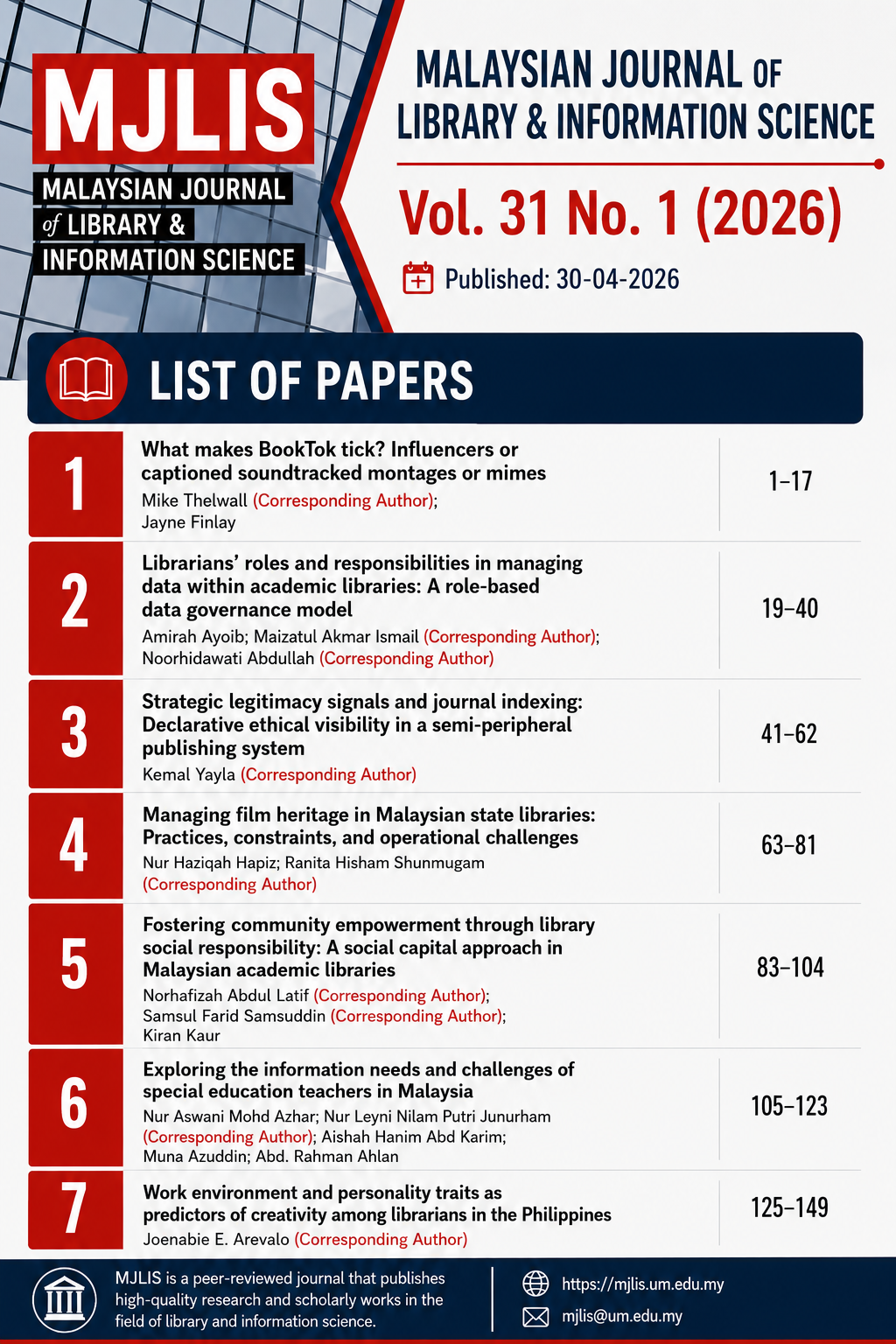
Fostering community empowerment through library social responsibility: A social capital approach in Malaysian academic libraries
DOI:
https://doi.org/10.22452/mjlis.vol31no1.5Keywords:
Library social responsibility, Social capital, Community empowerment, Academic libraries, MalaysiaAbstract
This study examines the understanding and implementation of social responsibility (SR) practices in Malaysian public academic libraries. Focusing on how these initiatives contribute to community development and empowerment through a social capital perspective, the inquiry was guided by two research questions: (i) How do academic librarians engage in social responsibility activities? (ii) How do academic library social responsibility practices foster community empowerment through the development of community social capital? Qualitative data were collected from 19 library administrator interviews and 19 focus group discussions with professional and non-professional library staff. The findings reveal that community empowerment does not result from isolated programmes but emerges through the interplay of structural networks, shared cognitive understanding, relational trust, and dimensions of social capital that operate synergistically. The study demonstrates that Library Social Responsibility (LSR) functions as a social capital-building process rather than a set of discrete charitable activities. Empirically, it specifies how partnership brokering, participatory needs alignment, and accumulative trust translate LSR into sustainable community capacity. Theoretically, it offers a moderated contribution: an empirically grounded elaboration of existing social capital theory applied to LSR contexts, rather than a new paradigm. Practically, the findings provide actionable insights for library managers and policymakers to design sustained, community-responsive LSR initiatives that position academic libraries as strategic agents of social inclusion and collaborative community development.
References
Abu Eid, S., & Che Hussin, N. (2022). Deriving factors for library corporate social responsibility using thematic and weighting analysis. Library Management, 43(67), 492-506. https://doi.org/10.1108/LM-05-2022-0048.
Abu Eid, S., & Che Hussin, N. (2024). Toward a library corporate social responsibility model: An empirical study. Journal of Librarianship and Information Science, 57(2), 450- 469. https://doi.org/10.1177/09610006231222624.
Ahmed, S. K. (2025). Sample size for saturation in qualitative research: Debates, definitions, and strategies. Journal of Medicine, Surgery, and Public Health, 5, 100171. https://doi.org/10.1016/j.glmedi.2024.10017.
Alexander, A. P. (2019). Lincoln and Guba’s quality criteria for trustworthiness. IDC International Journal, 6(4), 1-6.
Alsop, R., Bertelsen, M., & Holland, J. (2006). Empowerment in practice: From analysis to implementation. World Bank.
Bowen, H. R. (1953). Social responsibilities of the businessman. Harper & Row.
Bowles, S., & Gintis, H. (2002). Social capital and community governance. Economic Journal, 112(483), F419–F436. https://doi.org/10.1111/1468-0297.00077.
Boyatzis, R. E. (1998). Transforming qualitative information: Thematic analysis and code development. SAGE Publications.
Braun, V., & Clarke, V. (2021). One size fits all? What counts as quality practice in (reflexive) thematic analysis? Qualitative Research in Psychology, 18(3), 328–352. https://doi.org/10.1080/14780887.2020.1769238.
Burt, R. S. (2004). Structural holes and good ideas. American Journal of Sociology, 110, 349-399. https://doi.org/10.1086/421787.
Cao, O. T. (2021). The case of community libraries. In R. Hazenberg & C. Paterson-Young (Eds.), Social impact measurement for a sustainable future: The power of aesthetics and practical implications (pp. 169–183). Palgrave Macmillan. https://doi.org/10.1007/978-3-030-83152-3_8.
Carroll, A. B. (1991). The pyramid of corporate social responsibility: Toward the moral management of organizational stakeholders. Business Horizons, 34(4), 39–48. https://doi.org/10.1016/0007-6813(91)90005-G.
Carroll, A. B. (1999). Corporate social responsibility: Evolution of a definitional construct. Business & Society, 38(3), 268–295. https://doi.org/10.1177/000765039903800303.
César, M., & Jhony, A. (2020). Corporate social responsibility supports the construction of a strong social capital in the mining context: evidence from Peru. Journal of Cleaner Production, 267, 1-8. https://doi.org/10.1016/j.jclepro.2020.122162.
Cole, S., & Stenström, C. (2020). The Value of California’s Public Libraries. Public Library Quarterly,40(6),481-503. https://doi.org/10.1080/01616846.2020.1816054.
Enem, F. N., Benson, O. V., & Igbokwe, J. C. (2020). Libraries participation in corporate social responsibility activities for sustainable development in South Nigeria. Library Philosophy and Practice, Article 4143. Retrieved from https://digitalcommons.unl.edu/libphilprac/4143.
Ferreira, M. B., & Siebra, S. A. (2021). Librarians' social responsibility in public libraries dimensions and actions. Digital Journal of Library and Information Science, 19, 1-24. 10.20396/rdbci.v19i00.8665764/27286.
Kosciejew, M. (2019). Information’s importance for refugees: Information technologies, public libraries, and the current refugee crisis. The Library Quarterly, 89(2), 79-98. 10.1086/702193.
Matten, D., & Moon, J. (2008). ‘Implicit’ and ‘explicit’ CSR: A conceptual framework. Academy of Management Review, 33(2), 404–424. 10.5465/AMR.2008.31193458.
Mensah, M., & Onyancha, O. B. (2021). A social media strategy for academic libraries. The Journal of Academic Librarianship, 47(6), 102462. https://doi.org/10.1016/J.ACALIB.2021.102462.
Moxley, J., & Abbas, J. (2016). Envisioning libraries as collaborative community anchors for social service provision to vulnerable populations. Practice, 28(5), 311–330. https://doi.org/10.1080/09503153.2015.1135891.
Mubofu, C., & Mambo, H. (2021). The role of libraries in community empowerment: a systematic review. Indonesian Journal of Librarianship, 2(1), 1–16. 10.33701/ijolib.v2i1.1492.
Nahapiet, J., & Ghoshal, S. (1998). Social capital, intellectual capital, and the organizational advantage. Academy of Management Review, 23(2), 242–266. https://doi.org/10.5465/amr.1998.533225.
Nair, S. S. (2024). Role of libraries as a prerequisite to social well-being. International Journal of Research in Library Science, 10(2), 101–106. https://doi.org/10.26761/IJRLS.10.2.2024.1761.
Narayan, D. (1999). Bonds and bridges: Social capital and poverty. World Bank Policy Research Working Paper No. 2167. https://documents1.worldbank.org/curated/en/989601468766526606/pdf/multipage.pdf.
Omweri, F. S. (2024). A systematic literature review of e-government implementation in developing countries: examining urban-rural disparities, institutional capacity, and socio-cultural factors in the context of local governance and progress towards SDG 16.6. International Journal of Research and Innovation in Social Science, 8(8), 1173-1199. https://dx.doi.org/10.47772/IJRISS.2024.808088
Putnam, R. D. (2000). Bowling alone: The collapse and revival of American community. New York: Simon & Schuster LLC.
Rabasa T. A. & Abrizah, A. (2022). Academic librarians’ roles and competencies in research partnership: A qualitative study. Malaysian Journal of Library and Information Science, 27(3), 69–95. https://doi.org/10.22452/mjlis.vol27no3.4.
Rudito, B., Famiola, M., & Anggahegari, P. (2023). Corporate Social Responsibility and Social Capital: Journey of Community Engagement toward Community Empowerment Program in Developing Country. Sustainability, 15(1), 466. https://doi.org/10.3390/su15010466.
Saldaña, J. (2016). The coding manual for qualitative researchers. London, UK: SAGE.
Scott, W. (2014). Institutions and Organizations, Ideas, Interest and Identities. Sage Publications Inc. https://in.sagepub.com/en-in/sas/institutions-and-organizations/book237665.
Suharso, P., Yanto, A., Rohman, A. S., Wiratningsih, R., & Saefullah, R. S. (2018). Corporate social responsibility through the library for educational facilities. E3S Web of Conferences, 74, 08011. https://doi.org/10.1051/e3sconf/20187408011.
Tight, M. (2024). Saturation: An overworked and misunderstood concept? Qualitative Inquiry, 30(7), 577–583. https://doi.org/10.1177/10778004231183948.
Varheim, A. (2011). Gracious space. Library & Information Science Research, 33(1), 12–18. https://doi.org/10.1016/j.lisr.2010.04.005.
Varheim, A. (2014). Trust in libraries and trust in most people: Social capital creation in public libraries. The Library Quarterly, 84(3), 258–277. https://doi.org/10.1086/676487.https://www.jstor.org/stable/10.1086/676487?origin=JSTOR-pdf.
Williment, K. W. &T. Jones-Grant. (2012). Asset mapping at Halifax public libraries: A tool for beginning to discover the library’s role with the immigrant community in Halifax. Partnership: The Canadian Journal of Library and Information Practice and Research, 7(1). https://doi: 10.21083/partnership.v7i1.1491.
Wojciechowska, M. (2023). The importance and level of individual social capital among academic librarians. New Review of Academic Librarianship, 29(1), 51–76. https://doi.org/10.1080/13614533.2022.2079538.
Wojciechowska, M., & Topolski, M. (2024). Predictive modelling of social capital among library workers: A machine learning approach. Malaysian Journal of Library and Information Science, 29(1), 53–73. https://doi.org/10.22452/mjlis.vol29no1.3.
Woolcock, M. (2001). The place of social capital in understanding social and economic outcomes. Canadian Journal of Policy Research, 2(1), 11–17.
Woolcock, M., & Narayan, D. (2000). Social capital: Implications for development theory, research, and policy. World Bank Research Observer, 15(2), 225–249. https://doi.org/10.1093/wbro/15.2.225.
Zimmerman, M. A. (1995). Psychological empowerment: Issues and illustrations. American Journal of Community Psychology, 23(5), 581–599. https://doi.org/10.1007/BF02506983.
Zimmerman, M. A. (2000). Empowerment theory: Psychological, organizational, and community levels of analysis. In J. Rappaport & E. Seidman (Eds.), Handbook of community psychology (pp. 43–63). Springer. https://doi.org/10.1007/978-1-4615-4193-6_2.
Downloads
Published
Issue
Section
License
It is a condition of publication that manuscripts submitted to the journal have not been published, accepted for publication, nor simultaneously submitted for publication elsewhere. By submitting a manuscript, the author(s) agree that copyright for the article is transferred to the publisher, if and when the manuscript is accepted for publication.