Blue TiO2 Nanotube (b-TiO2) as a Support Material Electrode in a Photoelectrochemical Cell for Nitrogen Fixation
DOI:
https://doi.org/10.22452/mjs.vol44no3.6Keywords:
Keywords: Blue TiO2 Nanotube Arrays; Photo Electro Chemical (PEC) Cell; N2 Fixation; Artificial Photosynthesis.Abstract
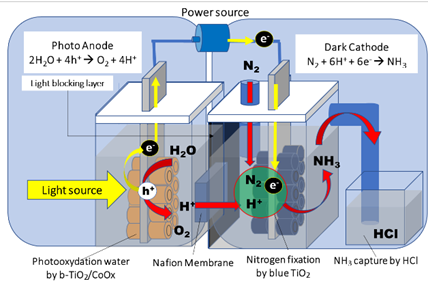
We have been developing an artificial photosynthesis device based on a photoelectrochemical cell to convert N2 to NH3 in a greener way as an alternative to the Haber–Bosch process, which requires high energy and releases a huge amount of CO2; this device consists of a dark cathode and photoanode. An electrode material that can absorb nitrogen and weaken its chemical bond is necessary for the dark cathode, while a photoanode material that can absorb visible light and have an intrinsic oxidation potential to split water is necessary. Currently, we are developing blue TiO2 (b-TiO2) and CoOx modified b-TiO2 for both electrode materials. b-TiO2 was synthesized by the electrochemical reduction of TiO2 nanotubes in aqueous solution, whereas TiO2 nanotubes were prepared using the electro-oxidation technique. The synthesized b-TiO2 exhibited a bandgap shift to 2.96 eV and an increase in conductivity owing to the presence of Ti3+ species. The addition of CoOx to b-TiO2 shifted the bandgap to 2.70 eV and increased its oxidative performance, as shown by the negative shift of the water oxidation onset potential and the 13.55% increase in RhB degradation under visible light and 500 mV external bias. Furthermore, when used in tandem as a dark cathode and photoanode, the device can convert N2 to NH3 up to 0.0063 µmol h−1 cm−1 without external bias and 0.0128 µmol h−1 cm−1 with 500 mV external bias.
References
Ali, Muataz et al. 2016. “Nanostructured Photoelectrochemical Solar Cell for Nitrogen Reduction Using Plasmon-Enhanced Black Silicon.” Nature Communications 7: 11335.
Amer, Mabrook S., Mohamed A. Ghanem, and Prabhakarn Arunachalam. 2019. “Mesoporous Titanium Dioxide Modified with Cobalt.” Catalysts 9(10).
Falcone, Marta et al. 2019. “The Role of Bridging Ligands in Dinitrogen Reduction and Functionalization by Uranium Multimetallic Complexes.” Nature Chemistry 11(2): 154–60.
Gupta, Shipra Mital, and Manoj Tripathi. 2011. “A Review of TiO2 Nanoparticles.” Chinese Science Bulletin 56(16): 1639–57. http://link.springer.com/10.1007/s11434-011-4476-1.
Hirakawa, Hiroaki, Masaki Hashimoto, Yasuhiro Shiraishi, and Takayuki Hirai. 2017. “Photocatalytic Conversion of Nitrogen to Ammonia with Water on Surface Oxygen Vacancies of Titanium Dioxide.” Journal of the American Chemical Society 139(31): 10929–36.
Hong, Sung Pil, Seonghwan Kim, Nayeong Kim, Jeyong Yoon, and Choonsoo Kim. 2019. “A Short Review on Electrochemically Self-Doped TiO2 Nanotube Arrays: Synthesis and Applications.” Korean Journal of Chemical Engineering 36(11): 1753–66.
Kang, Soon Hyung, Jae Yup Kim, Hyun Sik Kim, and Yung Eun Sung. 2008. “Formation and Mechanistic Study of Self-Ordered TiO2 Nanotubes on Ti Substrate.” Journal of Industrial and Engineering Chemistry 14(1): 52–9.
Keane, Andrew J., Wesley S. Farrell, Brendan L. Yonke, Peter Y. Zavalij, and Lawrence R. Sita. 2015. “Metal-Mediated Production of Isocyanates, Isocyanates, R3EN=C=Ofrom Dinitrogen, Carbon Dioxide, and R3ECl.” Angewandte Chemie 54(35): 10220–24.
Kim, Choonsoo, Seonghwan Kim, Sung Pil Hong, Jaehan Lee, and Jeyong Yoon. 2016. “Effect of Doping Level of Colored TiO2 Nanotube Arrays Fabricated by Electrochemical Self-Doping on Electrochemical Properties.” Physical Chemistry Chemical Physics 18(21): 14370–75.
Li, Chengcheng et al. 2018. “Promoted Fixation of Molecular Nitrogen with Surface Oxygen Vacancies on Plasmon-Enhanced TiO2 Photoelectrodes.” Angewandte Chemie 57(19): 5278–82.
Li, Hui et al. 2014. “Electrochemical Doping of Anatase TiO2 in Organic Electrolytes for High-Performance Supercapacitors and Photocatalysts.” J. Mater. Chem. A 2(1): 229–36.
Li, Mengqiao et al. 2019. “Recent Progress on Electrocatalyst and Photocatalyst Design for Nitrogen Reduction.” Small Methods 3(6): 1800388. http://doi.wiley.com/10.1002/smtd.201800388.
Li, Tengfei et al. 2017. “Photoelectrochemical Oxidation of Organic Substrates in Organic Media.” Nature Communications 8(1): 390.
Li, Yang et al. 2016. “Identification of Cobalt Oxides with Raman Scattering and Fourier Transform Infrared Spectroscopy.” Journal of Physical Chemistry C 120(8): 4511–16.
Ramakrishnan, Vivek, Hyun Kim, Jucheol Park, and Beelyong Yang. 2016. “Cobalt Oxide Nanoparticles on TiO2nanorod/FTO as a Photoanode with Enhanced Visible Light Sensitization.” RSC Advances 6(12): 9789–95.
Tang, Chih Wei, Chen Bin Wang, and Shu Hua Chien. 2008. “Characterization of Cobalt Oxides Studied by FT-IR, Raman, TPR and TG-MS.” Thermochimica Acta 473(1–2): 68–73.
Ullattil, Sanjay Gopal, Soumya B. Narendranath, Suresh C. Pillai, and Pradeepan Periyat. 2018. “Black TiO2 Nanomaterials: A Review of Recent Advances.” Chemical Engineering Journal 343(January): 708–36.
Yang, Jianhua, Yanzhen Guo, Wenzheng Lu, Ruibin Jiang, and Jianfang Wang. 2018a. “Emerging Applications of Plasmons in Driving CO2 Reduction and N2 Fixation.” Advanced Materials 30(48): e1802227.
Yang, Yang et al. 2018b. “Cobalt-Doped Black TiO2 Nanotube Array as a Stable Anode for Oxygen Evolution and Electrochemical Wastewater Treatment.” ACS Catalysis 8(5): 4278–87.
Ye, Wen et al. 2019. “Efficient Photoelectrochemical Route for the Ambient Reduction of N2 to NH3 Based on Nanojunctions Assembled from MoS2 Nanosheets and TiO2.” ACS Applied Materials and Interfaces 11(32): 28809–17.
Yu, Jianmin, Chau Thi Kim Nguyen, and Hyoyoung Lee. 2018. “Preparation of Blue TiO2 for Visible-Light-Driven Photocatalysis” Titanium Dioxide – Material for a Sustainable Environment. (edited by: D Yang). InTech.
Zhang, Guoqiang, Xun Yang, Chuanxin He, Peixin Zhang, and Hongwei Mi. 2020. “Constructing a Tunable Defect Structure in TiO2 for Photocatalytic Nitrogen Fixation.” Journal of Materials Chemistry A 8(1): 334–41.
Zhang, Rong et al. 2018. “Enabling Effective Electrocatalytic N2 Conversion to NH3 by the TiO2 Nanosheets Array under Ambient Conditions.” ACS Applied Materials and Interfaces 10(34): 28251–55.
Zheng, Jianyun et al. 2019. “Photoelectrochemical Synthesis of Ammonia on the Aerophilic-Hydrophilic Heterostructure with 37.8% Efficiency.” Chem 5(3): 617–33.
Zhou, He, and Yanrong Zhang. 2014. “Electrochemically Self-Doped TiO2 Nanotube Arrays for Supercapacitors.” Journal of Physical Chemistry C 118(11): 5626–36.
Zhu, Liyan et al. 2018. “Black TiO2 Nanotube Arrays Fabricated by Electrochemical Self-Doping and Their Photoelectrochemical Performance.” RSC Advances 8(34): 18992–9000.
Downloads
Published
Issue
Section
License
Copyright (c) 2025 Malaysian Journal of Science

This work is licensed under a Creative Commons Attribution-NonCommercial 4.0 International License.
Transfer of Copyrights
- In the event of publication of the manuscript entitled [INSERT MANUSCRIPT TITLE AND REF NO.] in the Malaysian Journal of Science, I hereby transfer copyrights of the manuscript title, abstract and contents to the Malaysian Journal of Science and the Faculty of Science, University of Malaya (as the publisher) for the full legal term of copyright and any renewals thereof throughout the world in any format, and any media for communication.
Conditions of Publication
- I hereby state that this manuscript to be published is an original work, unpublished in any form prior and I have obtained the necessary permission for the reproduction (or am the owner) of any images, illustrations, tables, charts, figures, maps, photographs and other visual materials of whom the copyrights is owned by a third party.
- This manuscript contains no statements that are contradictory to the relevant local and international laws or that infringes on the rights of others.
- I agree to indemnify the Malaysian Journal of Science and the Faculty of Science, University of Malaya (as the publisher) in the event of any claims that arise in regards to the above conditions and assume full liability on the published manuscript.
Reviewer’s Responsibilities
- Reviewers must treat the manuscripts received for reviewing process as confidential. It must not be shown or discussed with others without the authorization from the editor of MJS.
- Reviewers assigned must not have conflicts of interest with respect to the original work, the authors of the article or the research funding.
- Reviewers should judge or evaluate the manuscripts objective as possible. The feedback from the reviewers should be express clearly with supporting arguments.
- If the assigned reviewer considers themselves not able to complete the review of the manuscript, they must communicate with the editor, so that the manuscript could be sent to another suitable reviewer.
Copyright: Rights of the Author(s)
- Effective 2007, it will become the policy of the Malaysian Journal of Science (published by the Faculty of Science, University of Malaya) to obtain copyrights of all manuscripts published. This is to facilitate:
- Protection against copyright infringement of the manuscript through copyright breaches or piracy.
- Timely handling of reproduction requests from authorized third parties that are addressed directly to the Faculty of Science, University of Malaya.
- As the author, you may publish the fore-mentioned manuscript, whole or any part thereof, provided acknowledgement regarding copyright notice and reference to first publication in the Malaysian Journal of Science and Faculty of Science, University of Malaya (as the publishers) are given. You may produce copies of your manuscript, whole or any part thereof, for teaching purposes or to be provided, on individual basis, to fellow researchers.
- You may include the fore-mentioned manuscript, whole or any part thereof, electronically on a secure network at your affiliated institution, provided acknowledgement regarding copyright notice and reference to first publication in the Malaysian Journal of Science and Faculty of Science, University of Malaya (as the publishers) are given.
- You may include the fore-mentioned manuscript, whole or any part thereof, on the World Wide Web, provided acknowledgement regarding copyright notice and reference to first publication in the Malaysian Journal of Science and Faculty of Science, University of Malaya (as the publishers) are given.
- In the event that your manuscript, whole or any part thereof, has been requested to be reproduced, for any purpose or in any form approved by the Malaysian Journal of Science and Faculty of Science, University of Malaya (as the publishers), you will be informed. It is requested that any changes to your contact details (especially e-mail addresses) are made known.
Copyright: Role and responsibility of the Author(s)
- In the event of the manuscript to be published in the Malaysian Journal of Science contains materials copyrighted to others prior, it is the responsibility of current author(s) to obtain written permission from the copyright owner or owners.
- This written permission should be submitted with the proof-copy of the manuscript to be published in the Malaysian Journal of Science
Licensing Policy
Malaysian Journal of Science is an open-access journal that follows the Creative Commons Attribution-Non-commercial 4.0 International License (CC BY-NC 4.0)
CC BY – NC 4.0: Under this licence, the reusers to distribute, remix, alter, and build upon the content in any media or format for non-commercial purposes only, as long as proper acknowledgement is given to the authors of the original work. Please take the time to read the whole licence agreement (https://creativecommons.org/licenses/by-nc/4.0/legalcode ).