Extraction of Flavonoid from Rice Straw: The Study of Total Phenolic Content (TPC), Total Flavonoid Content (TFC) and Antibacterial Activity
DOI:
https://doi.org/10.22452/mjs.vol44no4.6Keywords:
rice straw, phenolic, flavonoid, anti-bacterialAbstract
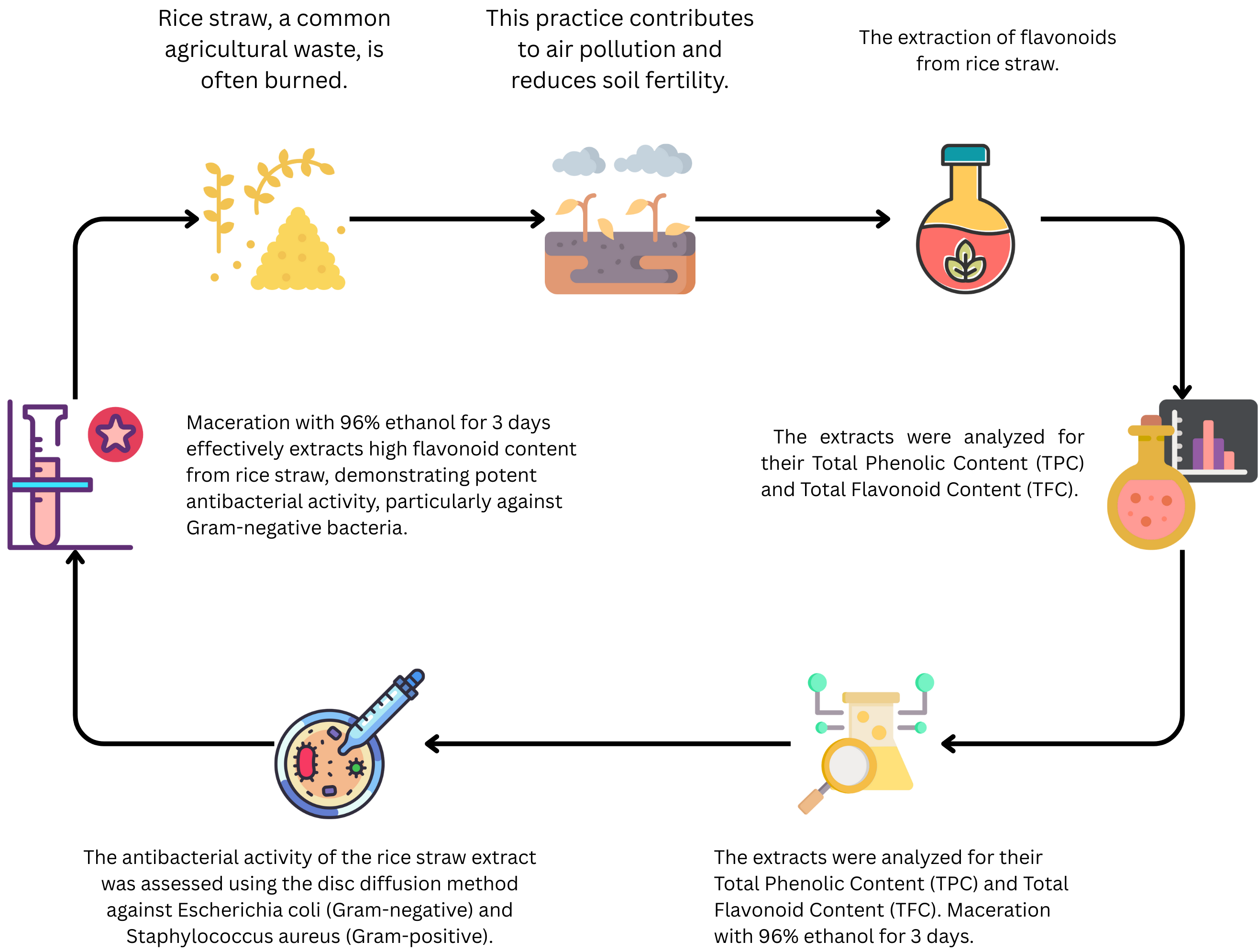
The combustion of rice straw results in air pollution and a decrease in soil fertility. This research aims to extract flavonoids from rice straw and evaluate their antibacterial properties. The extraction of flavonoids from rice straw was conducted using Soxhlet, reflux, and maceration methods. These extraction techniques were subsequently compared based on the Total Phenolic Content (TPC) and Total Flavonoid Content (TFC). The optimal extraction method for rice straw involved ethanol solvents with concentrations of 0%, 25%, 70%, and 96%. This same optimal method was used to extract rice straw at various time intervals, specifically 12 hours, one day, and three days. A comparative analysis of ethanol concentration and extraction duration was performed based on the Total Phenolic Content (TPC) and Total Flavonoid Content (TFC). The rice straw extract underwent the disc diffusion method for antibacterial tests against gram-positive (Staphylococcus aureus) and gram-negative (Escherichia coli) bacteria. The antibacterial efficacy of rice straw extract was evaluated based on its ability to inhibit the growth of these microorganisms. The maceration method proved to be the most effective for extracting rice straw due to its significantly greater total flavonoid content (TFC) value compared to the reflux and Soxhlet extraction methods. Increasing the ethanol concentration from 0% to 96% and extending the extraction time from 12 hours to 3 days led to a proportional increase in total phenolic content (TPC) and TFC. Ethanol at a concentration of 96% was the most appropriate solvent for extracting rice straw due to its highest total flavonoid content (TFC) value relative to other ethanol concentrations. A three-day extraction period was optimal, yielding a significantly higher TFC value than 12-hour and one-day extractions. Furthermore, it is noteworthy that rice straw extract exhibits greater inhibition of gram-negative bacteria (Escherichia coli) than gram-positive bacteria (Staphylococcus aureus). The antibacterial activity of rice straw extract correlated with the flavonoid content in the sample.
References
Abdelkader, M., Ahcen, B., Rachid, D., Hakim, H., & Materiel, A. P. (2014). Phytochemical Study and Biological Activity of Sage. International Journal of Biological, Biomolecular, Agricultural, Food and Biotechnological Engineering, 8(11), 1227–1231.
Agbor, G. A., Vinson, J. A., & Donnelly, P. E. (2014). Folin-Ciocalteau Reagent for Polyphenolic Assay. Int. J. Food Sci. Nutr. Diet., 3(801), 147–156. https://doi.org/10.19070/2326-3350-1400028
Al Farraj, D. A., Gawwad, M. R. A., Mehmood, A., Alsalme, A., Darwish, N. M., Al-Zaqri, N., & Warad, I. (2020). In-vitro antimicrobial activities of organic solvent extracts obtained from Dipcadi viride (L.) Moench. J. King Saud Univ. Sci., 32(3), 1965–1968. https://doi.org/10.1016/j.jksus.2020.01.007
Alide, T., Wangila, P., & Kiprop, A. (2020). Effect of cooking temperature and time on total phenolic content, total flavonoid content and total in vitro antioxidant activity of garlic. BMC Res. Notes, 13(1), 1–7. https://doi.org/10.1186/s13104-020-05404-8
Anukam, A., Mamphweli, S., Meyer, E., & Okoh, O. (2014). Computer Simulation of the Mass and Energy Balance during Gasification of Sugarcane Bagasse. J. Energy, 2014, 1–9. https://doi.org/10.1155/2014/713054
Bacon, K., Boyer, R., Denbow, C., O’Keefe, S., Neilson, A., & Williams, R. (2017). Evaluation of different solvents to extract antibacterial compounds from jalapeño peppers. Food Sci. Nutr., 5(3), 497–503. https://doi.org/10.1002/fsn3.423
Bahri-Sahloul, R., Fredj, B. R., Boughalleb, N., Shriaa, J., Saguem, S., Hilbert, J. L., Trotin, F., Ammar, S., Bouzid, S., & Harzallah-Skhiri, F. (2014). Phenolic composition and antioxidant and antimicrobial activities of extracts obtained from Crataegus azarolus L. var. aronia (Willd.) Batt. ovaries calli. J. Bot., 2014. https://doi.org/10.1155/2014/623651
Balaky, H. H., Galali, Y., Osman, A. A., Karaoğul, E., Altuntas, E., Uğuz, M. T., Galalaey, A. M. K., & Alma, M. H. (2020). Evaluation of antioxidant and antimicrobial activities of mandarin peel (Citrus reticulata blanco) with microwave assisted extract using two different solvents. Asian J. Plant Sci., 19(3), 223–229. https://doi.org/10.3923/ajps.2020.223.229
Bhaigyabati, T., Bag, G. C., & Grihanjali Devi, P. (2015). Assessment of total flavonoid content and antioxidant activity of methanolic rhizome extract of three Hedychium species of Manipur valley. Int. J. Pharm. Sci. Rev. Res., 30(1), 154–159.
Biharee, A., Sharma, A., Kumar, A., & Jaitak, V. (2020). Antimicrobial flavonoids as a potential substitute for overcoming antimicrobial resistance. Fitoterapia, 146, 104720. https://doi.org/10.1016/j.fitote.2020.104720
Blainski, A., Lopes, G. C., & De Mello, J. C. P. (2013). Application and analysis of the folin ciocalteu method for the determination of the total phenolic content from limonium brasiliense L. Molecules, 18(6), 6852–6865. https://doi.org/10.3390/molecules18066852
BPS-Indonesian Statistics. (2021). Luas Panen dan Produksi Padi di Indonesia 2021 (Harvest Area and Rice Production in Indonesia 2021). In Berita Resmi Statistik (Vol. 2021, Issue 77).
Chaaban, H., Ioannou, I., Chebil, L., Slimane, M., Gérardin, C., Paris, C., Charbonnel, C., Chekir, L., & Ghoul, M. (2017). Effect of heat processing on thermal stability and antioxidant activity of six flavonoids. J. Food Process. Preserv., 41(5). https://doi.org/10.1111/jfpp.13203
Chua, L. S., Latiff, N. A., & Mohamad, M. (2016). Reflux extraction and cleanup process by column chromatography for high yield of andrographolide enriched extract. J. Appl. Res. Med. Aromat. Plants, 3(2), 64–70. https://doi.org/10.1016/j.jarmap.2016.01.004
Chun, O. K., Kim, D. O., & Lee, C. Y. (2003). Superoxide Radical Scavenging Activity of the Major Polyphenols in Fresh Plums. J. Agric. Food Chem., 51(27), 8067–8072. https://doi.org/10.1021/jf034740d
Cui, X., Lamborg, C. H., Hammerschmidt, C. R., Xiang, Y., & Lam, P. J. (2021). The Effect of Particle Composition and Concentration on the Partitioning Coefficient for Mercury in Three Ocean Basins. Front. Env. Chem., 2(May), 1–16. https://doi.org/10.3389/fenvc.2021.660267
Cushnie, T. P. T., & Lamb, A. J. (2005). Antimicrobial activity of flavonoids. Int. J. Antimicrob. Agents, 26(5), 343–356. https://doi.org/10.1016/j.ijantimicag.2005.09.002
Dewi, A. L., Siregar, V. D., & Kusumayanti, H. (2019). Effect of Extraction Time on Tannin Antioxidant Level and Flavonoid on Pandan Wangi Leaf (Pandanusamary llifolius Roxb) Using Hydrothermal Extractor. J. Phys. Conf. Ser., 1295(1). https://doi.org/10.1088/1742-6596/1295/1/012066
Diniyah, N., Bulgis, U. M., & Novi Marchianti, A. C. (2023). Antioxidant activity and phytochemical compositions of Mucuna pruriens L. in different conditions of time and temperature extraction. IOP Conf. Ser.: Earth Environ. Sci., 1177(1), 012042. https://doi.org/10.1088/1755-1315/1177/1/012042
Donadio, G., Mensitieri, F., Santoro, V., Parisi, V., Bellone, M. L., De Tommasi, N., Izzo, V., & Piaz, F. D. (2021). Interactions with microbial proteins driving the antibacterial activity of flavonoids. Pharmaceutics, 13(5). https://doi.org/10.3390/pharmaceutics13050660
Elzaawely, A. A., Maswada, H. F., El-Sayed, M. E. A., & Ahmed, M. E. (2017). Phenolic Compounds and Antioxidant Activity of Rice Straw Extract. Int. Lett. Nat. Sci., 64, 1–9. https://doi.org/10.18052/www.scipress.com/ilns.64.1
Emelda, A., Fitriana, & Adnan, R. S. (2021). Antibacterial Activity of Ethanol Extract and Ethyl Acetate of Ginseng Bugis (Talinum Panicullatum Gaertn.) Leaves against Staphylococcus Aureus and Escherichia coli Bacteria. J. Phys. Conf. Ser., 1899(1). https://doi.org/10.1088/1742-6596/1899/1/012007
Fadillah, A., Rahmadani, A., & Rijai, L. (2007). Analysis of total flavonoid and antioxidant activity of Passion leaves (Passiflora foetida L.). Proceeding of the 5th Mulawarman Pharmaceuticals Conference, April, 23–24.
Gadde, B., Bonnet, S., Menke, C., & Garivait, S. (2009). Air pollutant emissions from rice straw open field burning in India, Thailand and the Philippines. Environ. Pollut., 157(5), 1554–1558. https://doi.org/10.1016/j.envpol.2009.01.004
Gao, Y., Xia, W., Shao, P., Wu, W., Chen, H., Fang, X., Mu, H., Xiao, J., & Gao, H. (2022). Impact of thermal processing on dietary flavonoids. Curr. Opin. Food Sci., 48, 100915. https://doi.org/10.1016/j.cofs.2022.100915
Ge, X., Jing, L., Zhao, K., Su, C., Zhang, B., Zhang, Q., Han, L., Yu, X., & Li, W. (2021). The phenolic compounds profile, quantitative analysis and antioxidant activity of four naked barley grains with different color. Food Chem., 335, 127655. https://doi.org/10.1016/j.foodchem.2020.127655
Górniak, I., Bartoszewski, R., & Króliczewski, J. (2019). Comprehensive review of antimicrobial activities of plant flavonoids. Phytochem. Rev., 18(1), 241–272. https://doi.org/10.1007/s11101-018-9591-z
Indriani, V., Chiuman, L., Wijaya, L. L., Lister, G., & Grandis, L. (2020). Antibacterial Effect of Curcuma zedoaria Extract on Bacillus cereus and Staphylococcus epidermidis. Althea Med. J., 7(1), 6–10. https://doi.org/10.15850/amj.v7n1.1886
Iwashina, T. (2015). Contribution to flower colors of flavonoids including anthocyanins: A review. Nat. Prod. Commun., 10(3), 529–544. https://doi.org/10.1177/1934578x1501000335
Karimi, E., Mehrabanjoubani, P., Keshavarzian, M., Oskoueian, E., Jaafar, H. Z., & Abdolzadeh, A. (2014). Identification and quantification of phenolic and flavonoid components in straw and seed husk of some rice varieties (Oryza sativa L.) and their antioxidant properties. J. Sci. Food Agric., 94(11), 2324–2330. https://doi.org/10.1002/jsfa.6567
Kumar, A., Kushwaha, K. K., Singh, S., Shivay, Y. S., Meena, M. C., & Nain, L. (2019). Effect of paddy straw burning on soil microbial dynamics in sandy loam soil of Indo-Gangetic plains. Environ. Technol. Innov., 16, 100469. https://doi.org/10.1016/j.eti.2019.100469
Lang, G. H., Lindemann, I. da S., Ferreira, C. D., Hoffmann, J. F., Vanier, N. L., & de Oliveira, M. (2019). Effects of drying temperature and long-term storage conditions on black rice phenolic compounds. Food Chem., 287, 197–204. https://doi.org/10.1016/j.foodchem.2019.02.028
Mandalari, G., Bennett, R. N., Bisignano, G., Trombetta, D., Saija, A., Faulds, C. B., Gasson, M. J., & Narbad, A. (2007). Antimicrobial activity of flavonoids extracted from bergamot (Citrus bergamia Risso) peel, a byproduct of the essential oil industry. J. Appl. Microbiol., 103(6), 2056–2064. https://doi.org/10.1111/j.1365-2672.2007.03456.x
Martono, Y., Yanuarsih, F. F., Aminu, N. R., & Muninggar, J. (2019). Fractionation and determination of phenolic and flavonoid compound from Moringa oleifera leaves. J. Phys. Conf. Ser., 1307(1). https://doi.org/10.1088/1742-6596/1307/1/012014
Mayerhöfer, T. G., & Popp, J. (2019). Beer’s Law – Why Absorbance Depends (Almost) Linearly on Concentration. Chem. Phys. Chem., 20(4), 511–515. https://doi.org/10.1002/cphc.201801073
Mekonnen, A., & Desta, W. (2021). Comparative study of the antioxidant and antibacterial activities of Rumex abyssinicus with commercially available Zingiber officinale and Curcuma longa in Bahir Dar city, Ethiopia. Chem. Biol. Technol. Agric., 8(1), 1–11. https://doi.org/10.1186/s40538-020-00198-0
Ministry of Home Affairs. (2004). Rice Commodity Profile. https://ews.kemendag.go.id/file/commodity/120116_ANK_PKM_DSK_Jagung Rev 1.4.pdf
Rabiu, A., & Haque, M. (2017). Preparation of Medicinal Plants: Basic Extraction and Fractionation Procedures for Experimental Purposes Article. Asian J. Pharm. Clin. Res., 7(10), 1–5. https://doi.org/10.4103/jpbs.JPBS
Rammohan, A., Bhaskar, B. V., Venkateswarlu, N., Rao, V. L., Gunasekar, D., & Zyryanov, G. V. (2019). Isolation of flavonoids from the flowers of Rhynchosia beddomei Baker as prominent antimicrobial agents and molecular docking. Microb. Pathog., 136, 1–7. https://doi.org/10.1016/j.micpath.2019.103667
Redfern, J., Kinninmonth, M., Burdass, D., & Verran, J. (2014). Tips & Tools Using Soxhlet Ethanol Extraction to Produce and Test Plant. J. Microbiol. Biol. Educ., 15(1), 45–46.
Romasanta, R. R., Sander, B. O., Gaihre, Y. K., Alberto, M. C., Gummert, M., Quilty, J., Nguyen, V. H., Castalone, A. G., Balingbing, C., Sandro, J., Correa, T., & Wassmann, R. (2017). How does burning of rice straw affect CH4 and N2O emissions? A comparative experiment of different on-field straw management practices. Agric. Ecosyst. Environ., 239, 143–153. https://doi.org/10.1016/j.agee.2016.12.042
Ross, C. F., Hoye, C., & Fernandez-Plotka, V. C. (2011). Influence of Heating on the Polyphenolic Content and Antioxidant Activity of Grape Seed Flour. J. Food Sci., 76(6), 884–890. https://doi.org/10.1111/j.1750-3841.2011.02280.x
Shi, L., Zhao, W., Yang, Z., Subbiah, V., & Suleria, H. A. R. (2022). Extraction and characterization of phenolic compounds and their potential antioxidant activities. Environ. Sci. Pollut. Res., 29(54), 81112–81129. https://doi.org/10.1007/s11356-022-23337-6
Shraim, A. M., Ahmed, T. A., Rahman, M. M., & Hijji, Y. M. (2021). Determination of total flavonoid content by aluminum chloride assay: A critical evaluation. Lwt, 150, 111932–111943. https://doi.org/10.1016/j.lwt.2021.111932
Silhavy, T. J., Kahne, D., & Walker, S. (2010). The Bacterial Cell Envelope. Cold Spring Harb. Perspect. Biol., 2(5), 1–16. https://doi.org/doi: 10.1101/cshperspect.a000414
Stavenga, D. G., Leertouwer, H. L., Dudek, B., & van der Kooi, C. J. (2021). Coloration of Flowers by Flavonoids and Consequences of pH Dependent Absorption. Front. Plant Sci., 11, 1–11. https://doi.org/10.3389/fpls.2020.600124
Tambun, R., Alexander, V., & Ginting, Y. (2021). Performance comparison of maceration method, soxhletation method, and microwave-assisted extraction in extracting active compounds from soursop leaves (Annona muricata): A review. IOP Conf. Ser.: Mater. Sci. Eng., 1122(1), 1–7. https://doi.org/10.1088/1757-899x/1122/1/012095
Tsao, R. (2010). Chemistry and biochemistry of dietary polyphenols. Nutrients, 2(12), 1231–1246. https://doi.org/10.3390/nu2121231
Vifta, R. L., Trinadi, K. S., & Suratno, S. (2022). Potential of Flavonoid Content from Clitoria ternatea Flowers Extract as Natural Antioxidant Candidate and Its Correlation. Proceedings of Conference on Health Universitas Ngudi Waluyo, 1, 53–60.
Vuolo, M. M., Lima, V. S., & Maróstica Junior, M. R. (2019). Phenolic Compounds: Structure, Classification, and Antioxidant Power. In Bioactive Compounds: Health Benefits and Potential Applications. Elsevier Inc. https://doi.org/10.1016/B978-0-12-814774-0.00002-5
Widiyastuti, W., Rois, M. F., Setyawan, H., Machmudah, S., & Anggoro, D. (2020). Carbonization of lignin extracted from liquid waste of coconut coir delignification. Indones. J. Chem., 20(4), 842–849. https://doi.org/10.22146/ijc.46484
Xie, Y., Yang, W., Tang, F., Chen, X., & Ren, L. (2014). Antibacterial Activities of Flavonoids: Structure-Activity Relationship and Mechanism. Curr. Med. Chem., 22(1), 132–149. https://doi.org/10.2174/0929867321666140916113443
Yusof, N., Abdul Munaim, M. S., & Veloo Kutty, R. (2020). The effects of different ethanol concentration on total phenolic and total flavonoid content in Malaysian Propolis. IOP Conf. Ser.: Mater. Sci. Eng., 991(1), 5–10. https://doi.org/10.1088/1757-899X/991/1/012033
Zhu, H., Wang, Y., Liu, Y., Xia, Y., & Tang, T. (2010). Analysis of flavonoids in Portulaca oleracea L. by UV-vis spectrophotometry with comparative study on different extraction technologies. Food Anal. Methods, 3(2), 90–97. https://doi.org/10.1007/s12161-009-9091-2
Downloads
Published
Issue
Section
License
Copyright (c) 2025 Malaysian Journal of Science

This work is licensed under a Creative Commons Attribution-NonCommercial 4.0 International License.
Transfer of Copyrights
- In the event of publication of the manuscript entitled [INSERT MANUSCRIPT TITLE AND REF NO.] in the Malaysian Journal of Science, I hereby transfer copyrights of the manuscript title, abstract and contents to the Malaysian Journal of Science and the Faculty of Science, University of Malaya (as the publisher) for the full legal term of copyright and any renewals thereof throughout the world in any format, and any media for communication.
Conditions of Publication
- I hereby state that this manuscript to be published is an original work, unpublished in any form prior and I have obtained the necessary permission for the reproduction (or am the owner) of any images, illustrations, tables, charts, figures, maps, photographs and other visual materials of whom the copyrights is owned by a third party.
- This manuscript contains no statements that are contradictory to the relevant local and international laws or that infringes on the rights of others.
- I agree to indemnify the Malaysian Journal of Science and the Faculty of Science, University of Malaya (as the publisher) in the event of any claims that arise in regards to the above conditions and assume full liability on the published manuscript.
Reviewer’s Responsibilities
- Reviewers must treat the manuscripts received for reviewing process as confidential. It must not be shown or discussed with others without the authorization from the editor of MJS.
- Reviewers assigned must not have conflicts of interest with respect to the original work, the authors of the article or the research funding.
- Reviewers should judge or evaluate the manuscripts objective as possible. The feedback from the reviewers should be express clearly with supporting arguments.
- If the assigned reviewer considers themselves not able to complete the review of the manuscript, they must communicate with the editor, so that the manuscript could be sent to another suitable reviewer.
Copyright: Rights of the Author(s)
- Effective 2007, it will become the policy of the Malaysian Journal of Science (published by the Faculty of Science, University of Malaya) to obtain copyrights of all manuscripts published. This is to facilitate:
- Protection against copyright infringement of the manuscript through copyright breaches or piracy.
- Timely handling of reproduction requests from authorized third parties that are addressed directly to the Faculty of Science, University of Malaya.
- As the author, you may publish the fore-mentioned manuscript, whole or any part thereof, provided acknowledgement regarding copyright notice and reference to first publication in the Malaysian Journal of Science and Faculty of Science, University of Malaya (as the publishers) are given. You may produce copies of your manuscript, whole or any part thereof, for teaching purposes or to be provided, on individual basis, to fellow researchers.
- You may include the fore-mentioned manuscript, whole or any part thereof, electronically on a secure network at your affiliated institution, provided acknowledgement regarding copyright notice and reference to first publication in the Malaysian Journal of Science and Faculty of Science, University of Malaya (as the publishers) are given.
- You may include the fore-mentioned manuscript, whole or any part thereof, on the World Wide Web, provided acknowledgement regarding copyright notice and reference to first publication in the Malaysian Journal of Science and Faculty of Science, University of Malaya (as the publishers) are given.
- In the event that your manuscript, whole or any part thereof, has been requested to be reproduced, for any purpose or in any form approved by the Malaysian Journal of Science and Faculty of Science, University of Malaya (as the publishers), you will be informed. It is requested that any changes to your contact details (especially e-mail addresses) are made known.
Copyright: Role and responsibility of the Author(s)
- In the event of the manuscript to be published in the Malaysian Journal of Science contains materials copyrighted to others prior, it is the responsibility of current author(s) to obtain written permission from the copyright owner or owners.
- This written permission should be submitted with the proof-copy of the manuscript to be published in the Malaysian Journal of Science
Licensing Policy
Malaysian Journal of Science is an open-access journal that follows the Creative Commons Attribution-Non-commercial 4.0 International License (CC BY-NC 4.0)
CC BY – NC 4.0: Under this licence, the reusers to distribute, remix, alter, and build upon the content in any media or format for non-commercial purposes only, as long as proper acknowledgement is given to the authors of the original work. Please take the time to read the whole licence agreement (https://creativecommons.org/licenses/by-nc/4.0/legalcode ).