High-Performance Liquid Chromatography Analysis of Caffeine and Trigonelline in Instant Coffee: A Malaysian Market Study
DOI:
https://doi.org/10.22452/mjs.vol44no4.5Keywords:
Caffeine, trigonelline, instant coffee, high-performance liquid chromatographyAbstract
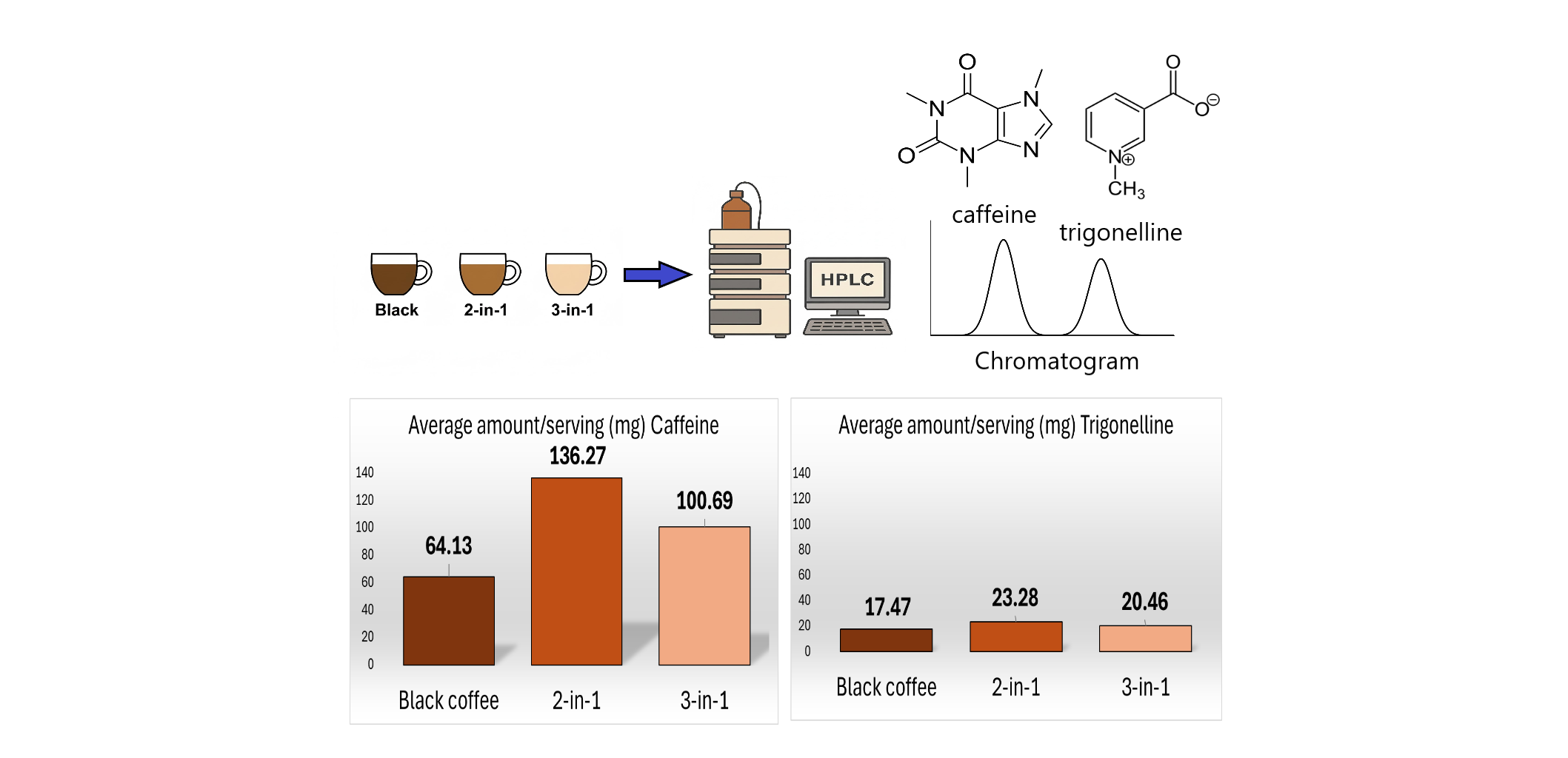
Caffeine and trigonelline are the main alkaloids found in coffee that play a significant role to its quality and impact on human well-being. However, exceeding the recommended intake can yield negative effects. In this study, a reverse phase high-performance liquid chromatography technique was validated for the concurrent quantification of caffeine and trigonelline within instant coffee products. The chromatographic separation was executed employing a GraceSmart RP C18 column under gradient elution consisting of water and methanol as the mobile phase, and heptafluorobutyric acid as an ion pairing agent. The validated method was utilised to determine the caffeine and trigonelline content in fifteen products, revealing concentrations ranging from 2.02 to 47.54 mg/g for caffeine and 0.37 to 11.00 mg/g for trigonelline. On a per-serving basis, this equated to 36.43–183.33 mg of caffeine and 6.70–41.41 mg of trigonelline. While the caffeine content per serving adhered to FDA safety guidelines, the potential for exceeding recommended daily intake of 400 mg was identified with multiple servings. Furthermore, one product exhibited a caffeine level only at 50.5% of its label claim. This study contributes valuable data on the caffeine and trigonelline content of Malaysian instant coffee, emphasizing the importance of accurate labelling and informed consumer choices.
References
Açıkalın, B., & Sanlier, N. (2021). Coffee and its effects on the immune system. Trends in Food Science and Technology, 114, 625–632. https://doi.org/10.1016/j.tifs.2021.06.023
Ali, N., & Ramanathan, R. (2021). Coffee consumption and the sustainability of the coffee industry in Malaysia. Trends in Undergraduate Research, 4(2), 91–10. https://doi.org/10.33736/tur.1911.2021
Arai, K., Terashima, H., Aizawa, S., Taga, A., Yamamoto, A., Tsutsumiuchi, K., & Kodama, S. (2015). Simultaneous determination of trigonelline, caffeine, chlorogenic acid and their related compounds in instant coffee samples by HPLC using an acidic mobile phase containing octanesulfonate. Analytical Sciences, 31, 831–835.
Cornelis, M. C. (2019). The impact of caffeine and coffee on human health. Nutrients, 11(2), 416. https://doi.org/10.3390/nu11020416
da Costa, B. R. B., El Haddad, L. P., Freitas, B. T., Marinho, P. A., & De Martinis, B. S. (2022). Pre-workout supplements marketed in Brazil: Caffeine quantification and caffeine daily intake assessment. Drug Testing and Analysis, 14(3), 567–577. https://doi.org/10.1002/dta.3043
de Almeida, S. A., Ferracane, J. L., da Silva, E. M., Mushashe, A. M., Merritt, J., Rocha, A. A., Noronha-Filho, J. D., de Almeida, R. V., & Poskus, L. T. (2021). Antimicrobial potential of resin matrices loaded with coffee compounds. Journal of Biomedical Materials Research - Part B Applied Biomaterials, 109(3), 428–435. https://doi.org/10.1002/jbm.b.34711
Depaula, J., & Farah, A. (2019). Caffeine consumption through coffee: Content in the beverage, metabolism, health benefits and risks. Beverages, 5(2), 37. https://doi.org/10.3390/beverages5020037
Duffy, E. W., Hall, M. G., Dillman Carpentier, F. R., Musicus, A. A., Meyer, M. L., Rimm, E., & Smith Taillie, L. (2021). Nutrition claims on fruit drinks are inconsistent indicators of nutritional profile: A content analysis of fruit drinks purchased by households with young children. Journal of the Academy of Nutrition and Dietetics, 121(1), 36-46.e4. https://doi.org/10.1016/j.jand.2020.08.009
Edwards, Q. A., Kulikov, S. M., & Garner-O’Neale, L. D. (2015). Caffeine in surface and wastewaters in Barbados, West Indies. SpringerPlus, 4(57), 1–12. https://doi.org/10.1186/s40064-015-0809-x
Epshtein, N. A., Sevastianova, V. L., & Koroleva, A. I. (2018). Investigation of robustness at validation of HPLC and UPLC methods: A modern approach including risk analysis. Drug Development & Registration Journal (Russia), 1(22), 96–109.
European Food Safety Authority (EFSA). (2015). Scientific opinion on the safety of caffeine. EFSA Journal, 13(5), 4102. https://doi.org/10.2903/j.efsa.2015.4102
Fiani, B., Zhu, L., Musch, B. L., Briceno, S., Andel, R., Sadeq, N., & Ansari, A. Z. (2021). The neurophysiology of caffeine as a central nervous system stimulant and the resultant effects on cognitive function. Cureus, 13(5), e15032. https://doi.org/10.7759/cureus.15032
Gant, A., Leyva, V. E., Gonzalez, A. E., & Maruenda, H. (2015). Validated HPLC-diode array detector method for simultaneous evaluation of six quality markers in coffee. Journal of AOAC International, 98(1), 98–102. https://doi.org/10.5740/jaoacint.14-113
Gonzales-Yépez, K. A., Vilela, J. L., & Reátegui, O. (2023). Determination of caffeine, theobromine, and theophylline by HPLC-DAD in beverages commonly consumed in Lima, Peru. International Journal of Food Science, 4323645. https://doi.org/https://doi.org/10.1155/2023/4323645
ICH. (2005). ICH harmonised tripartite guideline. Validation of analytical procedures-text and methodology Q2(R1).
Jahrami, H., Al-Mutarid, M., Penson, P. E., Al-Islam Faris, M., Saif, Z., & Hammad, L. (2020). Intake of caffeine and its association with physical and mental health status among university students in Bahrain. Foods, 9(4), 473. https://doi.org/10.3390/foods9040473
Kolb, H., Martin, S., & Kempf, K. (2021). Coffee and lower risk of type 2 diabetes: Arguments for a causal relationship. Nutrients, 13(4), 1144. https://doi.org/10.3390/nu13041144
Konstantinidis, N., Franke, H., Schwarz, S., & Lachenmeier, D. W. (2023). Risk assessment of trigonelline in coffee and coffee by-products. Molecules, 28(8), 3460. https://doi.org/10.3390/molecules28083460
Liu, H., Shao, J., Li, Q., Li, Y., Yan, H. M., & He, L. (2012). Determination of trigonelline, nicotinic acid, and caffeine in yunnan arabica coffee by microwave-assisted extraction and HPLC with two columns in series. Journal of AOAC International, 95(4), 1138–1141. https://doi.org/10.5740/jaoacint.11-275
Mohamadi, N., Sharififar, F., Pournamdari, M., & Ansari, M. (2018). A review on biosynthesis, analytical techniques, and pharmacological activities of trigonelline as a plant alkaloid. Journal of Dietary Supplements, 15(2), 207–222. https://doi.org/10.1080/19390211.2017.1329244
Narayan Biswal, B., Narayan Das, S., Kumar Das, B., & Rath, R. (2020). Can coffee combat caries? An in vitro study. Journal of Oral and Maxillofacial Pathology, 24(1), 64–67. https://doi.org/10.4103/jomfp.JOMFP
Nyoro, F. D., Sim, S. F., & Jeffrey Kimura, A. L. (2018). Estimation of caffeine content in coffee of Malaysian market using Fourier Transform Infrared (FTIR) spectroscopy. Trends in Undergraduate Research, 1(1), a16-22. https://doi.org/10.33736/tur.1137.2018
Ogutu, C., Cherono, S., Ntini, C., Wang, L., & Han, Y. (2022). Comprehensive analysis of quality characteristics in main commercial coffee varieties and wild Arabica in Kenya. Food Chemistry: X, 14, 100294. https://doi.org/10.1016/j.fochx.2022.100294
Olechno, E., Puścion-Jakubik, A., Zujko, M. E., & Socha, K. (2021). Influence of various factors on caffeine content in coffee brews. Foods, 10(6), 1208. https://doi.org/10.3390/foods10061208
Ravisankar, P., Naga Navya, C., Pravallika, D., & Navya, D. (2015). A review on step-by-step analytical method validation. IOSR Journal of Pharmacy, 5(10), 7–19. www.iosrphr.org
Rodak, K., Kokot, I., & Kratz, E. M. (2021). Caffeine as a factor influencing the functioning of the human body—friend or foe? Nutrients, 13(9), 3088. https://doi.org/10.3390/nu13093088
Safe, S., Kothari, J., Hailemariam, A., Upadhyay, S., Davidson, L. A., & Chapkin, R. S. (2023). Health benefits of coffee consumption for cancer and other diseases and mechanisms of action. International Journal of Molecular Sciences, 24(3), 2706. https://doi.org/10.3390/ijms24032706
Saud, S., & Salamatullah, A. M. (2021). Relationship between the chemical composition and the biological functions of coffee. Molecules, 26(24), 7634. https://doi.org/10.3390/molecules26247634
Seifert, S. M., Schaechter, J. L., Hershorin, E. R., & Lipshultz, S. E. (2011). Health effects of energy drinks on children, adolescents, and young adults. Pediatrics, 127(3), 511–528. https://doi.org/10.1542/peds.2009-3592
Seninde, D. R., & Chambers, E. (2020). Coffee flavor: A review. Beverages, 6(3), 44. https://doi.org/10.3390/beverages6030044
Standards & Industrial Research Institute of Malaysia. (1994). Malaysian Standard MS 1360. Penentuan untuk kopi campuran.
Syamimi, W., Zaman, W. K., Loh, S. P., & Mohd Esa, N. (2022). Quantification of selected bioactive compounds in instant coffee and their effect on gastric release using HGT-1 cells. Malaysian Journal of Medicine and Health Sciences, 18(1), 257–267.
UKEssays. (2018, January). Coffee culture in malaysia marketing essay. https://www.ukessays.com/essays/marketing/coffee-culture-in-malaysia-marketing-essay.php
van Dam, R. M., Hu, F. B., & Willett, W. C. (2020). Coffee, caffeine, and health. New England Journal of Medicine , 383(4), 369–378. https://doi.org/10.1056/nejmra1816604
Wei, F., Furihata, K., Koda, M., Hu, F., Miyakawa, T., & Tanokura, M. (2012). Roasting process of coffee beans as studied by nuclear magnetic resonance: Time course of changes in composition. Journal of Agricultural and Food Chemistry, 60(4), 1005–1012. https://doi.org/10.1021/jf205315r
Downloads
Published
Issue
Section
License
Copyright (c) 2025 Malaysian Journal of Science

This work is licensed under a Creative Commons Attribution-NonCommercial 4.0 International License.
Transfer of Copyrights
- In the event of publication of the manuscript entitled [INSERT MANUSCRIPT TITLE AND REF NO.] in the Malaysian Journal of Science, I hereby transfer copyrights of the manuscript title, abstract and contents to the Malaysian Journal of Science and the Faculty of Science, University of Malaya (as the publisher) for the full legal term of copyright and any renewals thereof throughout the world in any format, and any media for communication.
Conditions of Publication
- I hereby state that this manuscript to be published is an original work, unpublished in any form prior and I have obtained the necessary permission for the reproduction (or am the owner) of any images, illustrations, tables, charts, figures, maps, photographs and other visual materials of whom the copyrights is owned by a third party.
- This manuscript contains no statements that are contradictory to the relevant local and international laws or that infringes on the rights of others.
- I agree to indemnify the Malaysian Journal of Science and the Faculty of Science, University of Malaya (as the publisher) in the event of any claims that arise in regards to the above conditions and assume full liability on the published manuscript.
Reviewer’s Responsibilities
- Reviewers must treat the manuscripts received for reviewing process as confidential. It must not be shown or discussed with others without the authorization from the editor of MJS.
- Reviewers assigned must not have conflicts of interest with respect to the original work, the authors of the article or the research funding.
- Reviewers should judge or evaluate the manuscripts objective as possible. The feedback from the reviewers should be express clearly with supporting arguments.
- If the assigned reviewer considers themselves not able to complete the review of the manuscript, they must communicate with the editor, so that the manuscript could be sent to another suitable reviewer.
Copyright: Rights of the Author(s)
- Effective 2007, it will become the policy of the Malaysian Journal of Science (published by the Faculty of Science, University of Malaya) to obtain copyrights of all manuscripts published. This is to facilitate:
- Protection against copyright infringement of the manuscript through copyright breaches or piracy.
- Timely handling of reproduction requests from authorized third parties that are addressed directly to the Faculty of Science, University of Malaya.
- As the author, you may publish the fore-mentioned manuscript, whole or any part thereof, provided acknowledgement regarding copyright notice and reference to first publication in the Malaysian Journal of Science and Faculty of Science, University of Malaya (as the publishers) are given. You may produce copies of your manuscript, whole or any part thereof, for teaching purposes or to be provided, on individual basis, to fellow researchers.
- You may include the fore-mentioned manuscript, whole or any part thereof, electronically on a secure network at your affiliated institution, provided acknowledgement regarding copyright notice and reference to first publication in the Malaysian Journal of Science and Faculty of Science, University of Malaya (as the publishers) are given.
- You may include the fore-mentioned manuscript, whole or any part thereof, on the World Wide Web, provided acknowledgement regarding copyright notice and reference to first publication in the Malaysian Journal of Science and Faculty of Science, University of Malaya (as the publishers) are given.
- In the event that your manuscript, whole or any part thereof, has been requested to be reproduced, for any purpose or in any form approved by the Malaysian Journal of Science and Faculty of Science, University of Malaya (as the publishers), you will be informed. It is requested that any changes to your contact details (especially e-mail addresses) are made known.
Copyright: Role and responsibility of the Author(s)
- In the event of the manuscript to be published in the Malaysian Journal of Science contains materials copyrighted to others prior, it is the responsibility of current author(s) to obtain written permission from the copyright owner or owners.
- This written permission should be submitted with the proof-copy of the manuscript to be published in the Malaysian Journal of Science
Licensing Policy
Malaysian Journal of Science is an open-access journal that follows the Creative Commons Attribution-Non-commercial 4.0 International License (CC BY-NC 4.0)
CC BY – NC 4.0: Under this licence, the reusers to distribute, remix, alter, and build upon the content in any media or format for non-commercial purposes only, as long as proper acknowledgement is given to the authors of the original work. Please take the time to read the whole licence agreement (https://creativecommons.org/licenses/by-nc/4.0/legalcode ).