Coalbed Methane Potential of The Muara Enim Formation in The South Sumatera Basin as a Source of Natural Gas
DOI:
https://doi.org/10.22452/mjs.vol44no4.7Keywords:
Coal Bed Methane, coal, biomarker, aromatic hydrocarbon, GC-MS analyses, Muara EnimAbstract
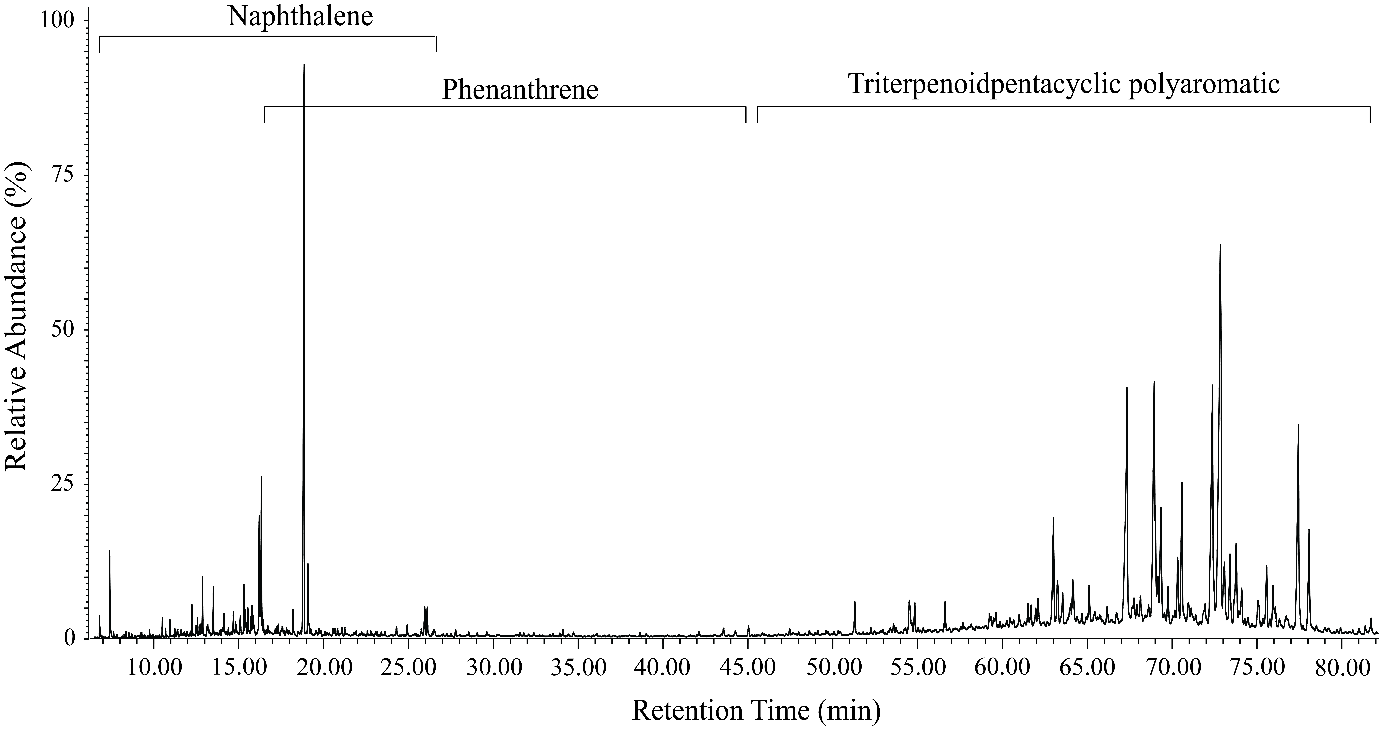
Identification of aromatic hydrocarbon fraction by biomarker analysis was carried out to determine the geochemical characteristics of the coal samples from the Muara Enim formation in the South Sumatra basin for potential coalbed methane (CBM) exploration and production. Biomarker analysis using gas chromatography-mass spectrometry (GC-MS) shows the distribution of naphthalene, phenanthrene, and pentacyclic polyaromatic triterpenoid compound groups. The high abundance of 1,2,5- and 1,2,7- trimethylnaphthalene (TMN) compounds indicates that the organic matter in the coal samples mostly originated from higher Angiosperm plants that were deposited in a terrestrial and oxic environment. This terrestrial depositional environment was also indicated by the dominance of the 1,6- and 1,7- dimethylphenanthrene (DMP) compounds. The low maturity of the analyzed coal was indicated by the dominance of less stable isomers over more stable isomers. The identification of 2- and 1- methylphenanthrene (MP) biomarkers that are associated with type II and type III kerogens in relatively high abundance indicates that the analyzed coal samples tend to produce oil and gas. However, the lower abundance value of 2,7-dimethyl-1,2-(isopropylpenteno)-1,2,3,4-tetrahydrochrysene compared to 1,2,4a,9-tetramethyl-1,2,3,4,4a ,5,6,14b-octahydropicene indicates that the coal samples from the Muara Enim formation possess a higher potential to produce gas than oil. In addition, the high vitrinite content in the samples is related to type III kerogen, which shows that the coal is more gas-prone than oil-prone. The obtained methylphenanthrene index (MPI) value of 0.99 indicates moderate maturity of coal. These implicatons show that the analyzed coal can be exploited for its CBM gas content.
References
Abdullah, E. S., Ebiad, M. A., Rashad, A. M., El Nady, M. M., & El-Sabbagh, S. M. (2021). Thermal maturity assessment of some Egyptian crude oils as implication from naphthalene, phenanthrene and alkyl substituents. Egyptian Journal of Petroleum, 30(1), 17–24. https://doi.org/10.1016/j.ejpe.2020.12.004
Aboglila, S., Abdulgader, A., Albaghdady, A., Hlal, O., & Farifr, E. (2019). Biomarker Ratios and Stablecarbon Isotopes to Describe Crude Oils Characteristics in the Murzuq Basin (Libya). Advances in Research, December, 1–12. https://doi.org/10.9734/air/2019/v18i330094
Akinlua, A., Dada, O. R., Usman, F. O., & Adekola, S. A. (2023). Source rock geochemistry of central and northwestern Niger Delta: Inference from aromatic hydrocarbons content. Energy Geoscience, 4(3), 100141. https://doi.org/10.1016/j.engeos.2022.100141
Amijaya, H., Schwarzbauer, J., & Littke, R. (2006). Organic geochemistry of the Lower Suban coal seam, South Sumatra Basin, Indonesia: Palaeoecological and thermal metamorphism implications. Organic Geochemistry, 37(3), 261–279. https://doi.org/10.1016/j.orggeochem.2005.10.012
Ayu, M. W. P., Burhan, P., & Zetra, Y. (2021). Analisis Biomarka Minyak Mentah Sumur Tua Blok Cepu, Formasi Wonocolo, Jawa Timur. Jurnal Sains Dan Seni ITS, 9(2), 1–6. https://doi.org/10.12962/j23373520.v9i2.56936
Bechtel, A., Chekryzhov, I. Y., Pavlyutkin, B. I., Nechaev, V. P., Dai, S., Vysotskiy, S. V., Velivetskaya, T. A., Tarasenko, I. A., & Guo, W. (2020). Composition of lipids from coal deposits of the Far East: Relations to vegetation and climate change during the Cenozoic. Palaeogeography, Palaeoclimatology, Palaeoecology, 538(April 2019), 109479. https://doi.org/10.1016/j.palaeo.2019.109479
Buckley, S., Power, R. C., Andreadaki-Vlazaki, M., Akar, M., Becher, J., Belser, M., Cafisso, S., Eisenmann, S., Fletcher, J., Francken, M., Hallager, B., Harvati, K., Ingman, T., Kataki, E., Maran, J., Martin, M. A. S., McGeorge, P. J. P., Milevski, I., Papadimitriou, A., … Stockhammer, P. W. (2021). Archaeometric evidence for the earliest exploitation of lignite from the bronze age Eastern Mediterranean. Scientific Reports, 11(1), 1–11. https://doi.org/10.1038/s41598-021-03544-w
Burhan, R. Y. P., Chairacita, A. M., Zetra, Y., & Mutiara, E. (2019). Biomarking Study of Aromatic Hydrocarbon Fraction Crude Oil Tarakan, North Kalimantan. Jurnal Teknik ITS, 8(2), 4–10. https://doi.org/10.12962/j23373539.v8i2.49743
Burhan, R. Y. P., Zetra, Y., & Amini, Y. A. (2020). Paleoenvironmental And Maturity Indicator Of Cepu Block Oil, Wonocolo Formation, East Java Indonesia. Jurnal Teknologi, 5, 173–182.
Dai, J., Ni, Y., Zou, C., Tao, S., Hu, G., Hu, A., Yang, C., & Tao, X. (2009). Stable carbon isotopes of alkane gases from the Xujiahe coal measures and implication for gas-source correlation in the Sichuan Basin, SW China. Organic Geochemistry, 40(5), 638–646. https://doi.org/10.1016/j.orggeochem.2009.01.012
Darman, H. (2000). An outline of the geology of Indonesia. Lecture Notes in Earth Sciences, 116(August), 1–31. https://doi.org/10.1007/978-3-540-77076-3_1
Ding, W., Hou, D., Gan, J., Zhang, Z., & George, S. C. (2022). Aromatic hydrocarbon signatures of the late Miocene-early Pliocene in the Yinggehai Basin, South China Sea: Implications for climate variations. Marine and Petroleum Geology, 142(March), 105733. https://doi.org/10.1016/j.marpetgeo.2022.105733
El-Sabagh, S. M., El-Naggar, A. Y., El Nady, M. M., Ebiad, M. A., Rashad, A. M., & Abdullah, E. S. (2018). Distribution of triterpanes and steranes biomarkers as indication of organic matters input and depositional environments of crude oils of oilfields in Gulf of Suez, Egypt. Egyptian Journal of Petroleum, 27(4), 969–977. https://doi.org/10.1016/j.ejpe.2018.02.005
ESDM. (2020). Handbook of Energy & Economic Statistics of Indonesia. Ministry of Energy and Mineral Resources Republic of Indonesia. https://www.esdm.go.id/en/publication/handbook-of-energy-economic-statistics-of-indonesia-heesi
Fadhliah, A., Zetra, Y., Wahyudi, A., & Burhan, R. Y. P. (2020). Biomarka sebagai Indikator Sumber Asal Usul Senyawa Organik Minyak Mentah Blok Cepu, Formasi Wonocolo, Bojonegoro, Jawa Timur. Jurnal Sains Dan Seni ITS, 9(2), 37–42. https://doi.org/10.12962/j23373520.v9i2.58293
Faiz, M., & Hendry, P. (2008). Microbial Activity in Australian CBM Reservoirs. *Adapted from Oral Presentation at AAPG Annual Convention, San Antonio, TX, April 20-23, 2008, 80033, 32.
Fang, R., Littke, R., Zieger, L., Baniasad, A., Li, M., & Schwarzbauer, J. (2019). Changes of composition and content of tricyclic terpane, hopane, sterane, and aromatic biomarkers throughout the oil window: A detailed study on maturity parameters of Lower Toarcian Posidonia Shale of the Hils Syncline, NW Germany. Organic Geochemistry, 138, 103928. https://doi.org/10.1016/j.orggeochem.2019.103928
Flores, R. M., Rice, C. A., Stricker, G. D., Warden, A., & Ellis, M. S. (2008). Methanogenic pathways of coal-bed gas in the Powder River Basin, United States: The geologic factor. International Journal of Coal Geology, 76(1–2), 52–75. https://doi.org/10.1016/j.coal.2008.02.005
Gan, H., Gong, S., Tian, H., Wang, H., Chen, J., Ma, Q., Liu, K., & Lv, Z. (2023). Geochemical characteristics of inclusion oils and charge history in the Fushan Sag, Beibuwan Basin, South China Sea. Applied Geochemistry, 150(February), 105598. https://doi.org/10.1016/j.apgeochem.2023.105598
Gao, L., Schimmelmann, A., Mastalerz, M., Schatzel, S. J., & Su, D. W. H. (2020). The origin of coalbed methane. In Coal Bed Methane: Theory and Applications (2nd ed.). Elsevier Inc. https://doi.org/10.1016/B978-0-12-815997-2.00001-9
Ghosh, S., Dutta, S., Bhattacharyya, S., Konar, R., & Priya, T. (2022). Paradigms of biomarker and PAH distributions in lower Gondwana bituminous coal lithotypes. International Journal of Coal Geology, 260(July), 104067. https://doi.org/10.1016/j.coal.2022.104067
He, C., Huang, H., Wang, Q., & Li, Z. (2019). Correlation of Maturity Parameters Derived from Methylphenanthrenes and Methyldibenzothiophenes in the Carboniferous Source Rocks from Qaidam Basin, NW China. Geofluids, 2019. https://doi.org/10.1155/2019/5742902
Huang, Q., Liu, S., Wang, G., Wu, B., & Zhang, Y. (2019). Coalbed methane reservoir stimulation using guar-based fracturing fluid: A review. Journal of Natural Gas Science and Engineering, 66(September 2018), 107–125. https://doi.org/10.1016/j.jngse.2019.03.027
Jiang, L., & George, S. C. (2019). Biomarker signatures of Upper Cretaceous Latrobe Group petroleum source rocks, Gippsland Basin, Australia: Distribution and geological significance of aromatic hydrocarbons. Organic Geochemistry, 138, 103905. https://doi.org/10.1016/j.orggeochem.2019.103905
Jurek, K. J., & Kowalski, A. (2022). Origin of Carpathian ozokerite deposits: determined from biomarkers and aromatic hydrocarbons distributions. Fuel, 310(PB), 122357. https://doi.org/10.1016/j.fuel.2021.122357
Killops, S., & Killops, V. (2005). Introduction to Organic Geochemistry (2nd editio). Blackwell Publishing Ltd.
Kim, J. H., Lee, D. H., Yoon, S. H., Jeong, K. S., Choi, B., & Shin, K. H. (2017). Contribution of petroleum-derived organic carbon to sedimentary organic carbon pool in the eastern Yellow Sea (the northwestern Pacific). Chemosphere, 168, 1389–1399. https://doi.org/10.1016/j.chemosphere.2016.11.110
Körmös, S., Sachsenhofer, R. F., Bechtel, A., Radovics, B. G., Milota, K., & Schubert, F. (2021). Source rock potential, crude oil characteristics and oil-to-source rock correlation in a Central Paratethys sub-basin, the Hungarian Palaeogene Basin (Pannonian basin). Marine and Petroleum Geology, 127(January). https://doi.org/10.1016/j.marpetgeo.2021.104955
Li, Z., Huang, H., & George, S. C. (2022). Unusual occurrence of alkylnaphthalene isomers in upper Eocene to Oligocene sediments from the western margin of Tasmania, Australia. Organic Geochemistry, 168(April), 104418. https://doi.org/10.1016/j.orggeochem.2022.104418
Li, Z., Huang, H., Yan, G., Xu, Y., & George, S. C. (2022). Occurrence and origin of perylene in Paleogene sediments from the Tasmanian Gateway, Australia. Organic Geochemistry, 168(November 2021), 104406. https://doi.org/10.1016/j.orggeochem.2022.104406
Lima, B. D., Martins, L. L., Pereira, V. B., Franco, D. M. M., dos Santos, I. R., Santos, J. M., Vaz, B. G., Azevedo, D. A., & da Cruz, G. F. (2023). Weathering impacts on petroleum biomarker, aromatic, and polar compounds in the spilled oil at the northeast coast of Brazil over time. Marine Pollution Bulletin, 189(February). https://doi.org/10.1016/j.marpolbul.2023.114744
Martini, A. M., Walter, L. M., & McIntosh, J. C. (2008). Identification of microbial and thermogenic gas components from Upper Devonian black shale cores, Illinois and Michigan basins. American Association of Petroleum Geologists Bulletin, 92(3), 327–339. https://doi.org/10.1306/10180706037
Mayumi, D., Mochimaru, H., Tamaki, H., Yamamoto, K., Yoshioka, H., Suzuki, Y., Kamagata, Y., & Sakata, S. (2016). Methane production from coal by a single methanogen. Science, 354(6309), 222–225. https://doi.org/10.1126/science.aaf8821
McIntosh, J., Martini, A., Petsch, S., Huang, R., & Nüsslein, K. (2008). Biogeochemistry of the Forest City Basin coalbed methane play. International Journal of Coal Geology, 76(1–2), 111–118. https://doi.org/10.1016/j.coal.2008.03.004
Nugroho, H. (2017). Coal as the National Energy Supplier Forward: What are Policies to be Prepared? Jurnal Perencanaan Pembangunan: The Indonesian Journal of Development Planning, 1(1), 1–13. https://doi.org/10.36574/jpp.v1i1.3
Ogungbesan, G. O., & Adedosu, T. A. (2020). Geochemical record for the depositional condition and petroleum potential of the Late Cretaceous Mamu Formation in the western flank of Anambra Basin, Nigeria. Green Energy and Environment, 5(1), 83–96. https://doi.org/10.1016/j.gee.2019.01.008
Qiao, J., Grohmann, S., Baniasad, A., Zhang, C., Jiang, Z., & Littke, R. (2021). High microbial gas potential of Pleistocene lacustrine deposits in the central Qaidam Basin, China: An organic geochemical and petrographic assessment. International Journal of Coal Geology, 245(July), 103818. https://doi.org/10.1016/j.coal.2021.103818
Rice, D. D. (1993). Composition and Origins of Coalbed Gas (Vol. 98, Issue 93, pp. 9885–9907). American Association of Petroleum Geologists. https://doi.org/10.1306/St38577C7
Rice, D. D., & Claypool, G. E. (1981). Generation , Accumulation , and Resource Potential of Biogenic Gas ’.
Rontani, J. F., Galeron, M. A., Amiraux, R., Artigue, L., & Belt, S. T. (2017). Identification of di- and triterpenoid lipid tracers confirms the significant role of autoxidation in the degradation of terrestrial vascular plant material in the Canadian Arctic. Organic Geochemistry, 108, 43–50. https://doi.org/10.1016/j.orggeochem.2017.03.011
Scott, C. D., Woodward, C. A., & Scott, T. C. (1994). Mechanisms and effects of using chemically modified reducing enzymes to enhance the conversion of coal to liquids. Fuel Processing Technology, 40(2–3), 319–329. https://doi.org/10.1016/0378-3820(94)90154-6
Sharma, R., Jha, S. K., Pal, S., & Shrivastava, J. P. (2022). Organic molecules based palaeoenvironmental inferences and U mineralization in Palaeoproterozoic Bijawar basins of Central India. Applied Geochemistry, 147(October), 105489. https://doi.org/10.1016/j.apgeochem.2022.105489
Sharma, S., Saxena, A., & Saxena, N. (2019). Introduction to Gas Hydrate, In: Unconventional Resources in India: The Way Ahead. SpringerBriefs in Petroleum Geoscience & Engineering. https://doi.org/10.1007/978-3-030-21414-2
Simoneit, B. R. T., Oros, D. R., Karwowski, Ł., Szendera, Ł., Smolarek-Lach, J., Goryl, M., Bucha, M., Rybicki, M., & Marynowski, L. (2020). Terpenoid biomarkers of ambers from Miocene tropical paleoenvironments in Borneo and of their potential extant plant sources. International Journal of Coal Geology, 221(December 2019), 103430. https://doi.org/10.1016/j.coal.2020.103430
Sosrowidjojo, I. B. (2013). Coal Geochemistry of the Unconventional Muaraenim Coalbed Reservoir , South Sumatera Basin : a Case Study From the Rambutan Field. Indonesian Mining Journal, 16(2), 71–81.
Sosrowidjojo, I. B., & Sagha, A. (2009). International Journal of Coal Geology Development of the fi rst coal seam gas exploration program in Indonesia : Reservoir properties of the Muaraenim Formation , south Sumatra. 79, 145–156. https://doi.org/10.1016/j.coal.2009.07.002
Stanford, C. E. (2013). Coal Resources, Production and Use in Indonesia. In The Coal Handbook: Towards Cleaner Production (Vol. 2). Woodhead Publishing Limited. https://doi.org/10.1533/9781782421177.2.200
Strapoć, D., Mastalerz, M., Eble, C., & Schimmelmann, A. (2007). Characterization of the origin of coalbed gases in southeastern Illinois Basin by compound-specific carbon and hydrogen stable isotope ratios. Organic Geochemistry, 38(2), 267–287. https://doi.org/10.1016/j.orggeochem.2006.09.005
Synnott, D. P., Schwark, L., Dewing, K., Percy, E. L., & Pedersen, P. K. (2021). The diagenetic continuum of hopanoid hydrocarbon transformation from early diagenesis into the oil window. Geochimica et Cosmochimica Acta, 308, 136–156. https://doi.org/10.1016/j.gca.2021.06.005
Theuerkorn, K., Horsfield, B., Wilkes, H., di Primio, R., & Lehne, E. (2008). A reproducible and linear method for separating asphaltenes from crude oil. Organic Geochemistry, 39(8), 929–934. https://doi.org/10.1016/j.orggeochem.2008.02.009
Wang, Q., Huang, H., He, C., Li, Z., & Zheng, L. (2022). Methylation and demethylation of naphthalene homologs in highly thermal mature sediments. Organic Geochemistry, 163(September 2021), 104343. https://doi.org/10.1016/j.orggeochem.2021.104343
Whiticar, M. J. (1999). Carbon and hydrogen isotope systematics of bacterial formation and oxidation of methane.
Yasin, C. M., Yunianto, B., Sugiarti, S., & Hudaya, G. K. (2021). Implementation of Indonesia coal downstream policy in the trend of fossil energy transition. IOP Conference Series: Earth and Environmental Science, 882(1). https://doi.org/10.1088/1755-1315/882/1/012083
Zajuli, M. H. H., Panggabean, H., Hendarmawan, & Syafri, I. (2017). Hubungan Kelompok Maseral Liptinit dan Vitrinit dengan Tipe Kerogen Relationship Between Liptinite and Vitrinite Maceral Groups with Kerogen Type of Hydrocarbon Source Rock on The Shale of Upper Kelesa Formation in Kuburan Panjang, Riau. Jurnal Geologi Dan Sumberdaya Mineral, 18(1), 13–23. http://jgsm.geologi.esdm.go.id
Zakrzewski, A., & Kosakowski, P. (2021). Impact of palaeo-wildfires on higher plant parameter revealed by new biomarker indicator. Palaeogeography, Palaeoclimatology, Palaeoecology, 579(April). https://doi.org/10.1016/j.palaeo.2021.110606
Zetra, Y., Sosrowidjojo, I. B., & Perry Burhan, R. Y. (2016). Aromatic biomarker from brown coal, Sangatta coalfield, East Borneo of middle miocene to late miocene age. Jurnal Teknologi, 78(6), 229–238. https://doi.org/10.11113/jt.v78.8822
Zhang, M., & Li, Z. (2018). Thermal maturity of the Permian Lucaogou Formation organic-rich shale at the northern foot of Bogda Mountains, Junggar Basin (NW China): Effective assessments from organic geochemistry. Fuel, 211(5268), 278–290. https://doi.org/10.1016/j.fuel.2017.09.069
Zheng, T., Zhang, Q., & Deng, E. (2023). Applications of low molecular weight polycyclic aromatic hydrocarbons (PAHs) and diamondoids ratios/indices on the maturity assessment of coal-bearing source rock: Insight from mature to overmature Longtan Shale. International Journal of Coal Geology, 269(November 2022), 104209. https://doi.org/10.1016/j.coal.2023.104209
Downloads
Published
Issue
Section
License
Copyright (c) 2025 Malaysian Journal of Science

This work is licensed under a Creative Commons Attribution-NonCommercial 4.0 International License.
Transfer of Copyrights
- In the event of publication of the manuscript entitled [INSERT MANUSCRIPT TITLE AND REF NO.] in the Malaysian Journal of Science, I hereby transfer copyrights of the manuscript title, abstract and contents to the Malaysian Journal of Science and the Faculty of Science, University of Malaya (as the publisher) for the full legal term of copyright and any renewals thereof throughout the world in any format, and any media for communication.
Conditions of Publication
- I hereby state that this manuscript to be published is an original work, unpublished in any form prior and I have obtained the necessary permission for the reproduction (or am the owner) of any images, illustrations, tables, charts, figures, maps, photographs and other visual materials of whom the copyrights is owned by a third party.
- This manuscript contains no statements that are contradictory to the relevant local and international laws or that infringes on the rights of others.
- I agree to indemnify the Malaysian Journal of Science and the Faculty of Science, University of Malaya (as the publisher) in the event of any claims that arise in regards to the above conditions and assume full liability on the published manuscript.
Reviewer’s Responsibilities
- Reviewers must treat the manuscripts received for reviewing process as confidential. It must not be shown or discussed with others without the authorization from the editor of MJS.
- Reviewers assigned must not have conflicts of interest with respect to the original work, the authors of the article or the research funding.
- Reviewers should judge or evaluate the manuscripts objective as possible. The feedback from the reviewers should be express clearly with supporting arguments.
- If the assigned reviewer considers themselves not able to complete the review of the manuscript, they must communicate with the editor, so that the manuscript could be sent to another suitable reviewer.
Copyright: Rights of the Author(s)
- Effective 2007, it will become the policy of the Malaysian Journal of Science (published by the Faculty of Science, University of Malaya) to obtain copyrights of all manuscripts published. This is to facilitate:
- Protection against copyright infringement of the manuscript through copyright breaches or piracy.
- Timely handling of reproduction requests from authorized third parties that are addressed directly to the Faculty of Science, University of Malaya.
- As the author, you may publish the fore-mentioned manuscript, whole or any part thereof, provided acknowledgement regarding copyright notice and reference to first publication in the Malaysian Journal of Science and Faculty of Science, University of Malaya (as the publishers) are given. You may produce copies of your manuscript, whole or any part thereof, for teaching purposes or to be provided, on individual basis, to fellow researchers.
- You may include the fore-mentioned manuscript, whole or any part thereof, electronically on a secure network at your affiliated institution, provided acknowledgement regarding copyright notice and reference to first publication in the Malaysian Journal of Science and Faculty of Science, University of Malaya (as the publishers) are given.
- You may include the fore-mentioned manuscript, whole or any part thereof, on the World Wide Web, provided acknowledgement regarding copyright notice and reference to first publication in the Malaysian Journal of Science and Faculty of Science, University of Malaya (as the publishers) are given.
- In the event that your manuscript, whole or any part thereof, has been requested to be reproduced, for any purpose or in any form approved by the Malaysian Journal of Science and Faculty of Science, University of Malaya (as the publishers), you will be informed. It is requested that any changes to your contact details (especially e-mail addresses) are made known.
Copyright: Role and responsibility of the Author(s)
- In the event of the manuscript to be published in the Malaysian Journal of Science contains materials copyrighted to others prior, it is the responsibility of current author(s) to obtain written permission from the copyright owner or owners.
- This written permission should be submitted with the proof-copy of the manuscript to be published in the Malaysian Journal of Science
Licensing Policy
Malaysian Journal of Science is an open-access journal that follows the Creative Commons Attribution-Non-commercial 4.0 International License (CC BY-NC 4.0)
CC BY – NC 4.0: Under this licence, the reusers to distribute, remix, alter, and build upon the content in any media or format for non-commercial purposes only, as long as proper acknowledgement is given to the authors of the original work. Please take the time to read the whole licence agreement (https://creativecommons.org/licenses/by-nc/4.0/legalcode ).