Impacts of Soil Environmental Factors on Variability of Soil Organic Carbon and Particle Size Fractions in Obudu Cattle Ranch, Nigeria
DOI:
https://doi.org/10.22452/mjs.vol44no4.8Keywords:
SOC, environmental elements, models, soilsAbstract
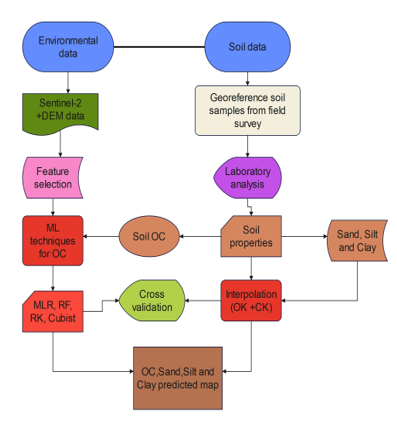
The knowledge of the influence of environmental factors on soil properties and spatial distribution of soil organic carbon (SOC) and soil particle size fractions is crucial to soil management and sustainable productivity. SOC provides an insight about soil capacity to perform ecosystem services while soil particle size fractions influence several key soil characteristics. This study assessed the impacts of environmental elements on spatial changes in SOC and sand, silt and clay using random forest (RF), regression kriging (RK), cubist regression (CR), multiple linear regression (MLR) and ordinary kriging (OK) models. Sixty (60) composite soil samples were obtained at 0-30 cm depth and distance of 200-500 m apart, and analyzed for physicochemical properties. The digital elevation model (DEM) of the area was acquired at the spatial resolution of 30 m from USGS and processed. The models were evaluated using bias, coefficient of determination (R2), correlation concordance coefficient (CCC), mean square error (MSE) and root mean square error (RMSE). The soil had sandy clay loam, sandy loam and loam texture with strongly acidic pH (pH <5.5) and high OC (2%). Available P and exchangeable cations were all low while cation exchange capacity and base saturation were high. Soil pH> SAVI (soil adjusted vegetation index)> NDVI (normalized difference vegetative index) > rainfall were found to be the top four environmental variables influencing OC prediction while temperature and slope had the least effect. Again, MLR model better predicted OC (R2 of 0.324, CCC of 0.537, MSE of 0.585, RMSE of 0.764), OK better predicted clay (MSE=2.680, RMSE=3.490), CK in sand (MSE = 7.434, RMSE =5.568). Also, MLR, CK and OK proved to have the best capacity in prediction SOC and sand, silt and clay in mountainous soils. The findings could therefore could be used by policy makers and planners as tools for decision making on sustainable soil and environmental management alternatives and precision agriculture.
References
AbdelRahman, M.A., Shalaby, A., Aboelsoud, M. H. & Moghanm, F. S. (2018). Spatial model based for determining actual land degradation status in Kafr El-Sheikh governorate, north Nile Delta. Modeling Earth Systems and Environment. 4(1), 359-372.
Adhikari K., Owens P.R., Libohova Z., Miller D.M., Wills S.A. & Nemecek J. (2019) Assessing soil organic carbon stock of Wisconsin, USA and its fate under future land use and climate change. Science of the Total Environment. 667: 833-845.
Afu, S.M., Adie, P.I., Olim,D.M., Isong, A.I., Akpama, A.I. & Aaron, M.E.(2022) Properties of soils of different lithology in the humid tropics of southeastern Nigeria. Global Journal of Agricultural Sciences. 21, 93-103
Bamutaze, Y., Meadows, M.E., Mwanjalolo, M. & Musinguzi, P. (2021) Effect of land use systems and topographical attributes on the condition of surface soil physicochemical properties in a highland catchment of the Lake Victoria Basin, Uganda. Catena. 203. 105343.
Bangroo, S.A., Najar, G.R. & Rasool, A. (2017). Effect of altitude and aspect on soil organic carbon and nitrogen stocks in the Himalayan Mawer Forest Range. Catena. 158. 63-68.
Barrena-Gonzalez, J., Gabourel-Landaverde, V.A., Mora, J., Contador, J.F.L. & Fernandez, M.P. (2023) Exploring soil property spatial patterns in a small grazed catchment using machine learning. Earth Science Information. 16:3811-3838.
Cambardella, C., Moonan, T.B., Nocak, J.M., Patkin, T.B., Katlem, D.L., Turvo, R.F., & Konopa, A.T. (1994) Field scale variability of soil properties in central Iowa soil. Soil Science Society of America Journal, 47, 15011511.
Cotrufo, M.F., Ranalli, M.G., Haddix, M.L., Six J. & Lugato M. (2019) Soil carbon storage informed by particulate and mineral-associated organic matter. Nat. Geosci. 12: 989–994. https://doi.org/10.1038/s41561-019-0484-6
De Menezes, M. D., Silva, S. H. G., de Mello, C. R., Owens, P. R. & Curi, N. (2016) Spatial prediction of soil properties in two contrasting physiographic regions in Brazil. Scientia Agricola 73 (3) 274 – 284.
Essoka, A., Ibanga, I. & Amalu, U. C. (2010) Physical Properties of the Mountain Soils of Cross River State, Nigeria. Nigerian Journal of Soil Science. 19(2)
Falahatkar, S., Hosseini M. S., Ayoubi, S. & Mahiny, A. S. (2016) Predicting soil organic carbon density using auxiliary environmental variables in northern Iran. Arch. Agron. Soil Sci., 62, 375-393.
Farooq, I., Bangroo, S.A., Owais, B., Shah, T.I., Mlik, A.A., Igbal, A.M., Mahdi, S.S., Wani, O.A, Nazir, N. & Biswas, A. (2022) Comparing random forest and kriging models for soil organic mapping in the Himalayan Region of KASHMIR. Land.11(12).
Feng, Z., Wang, L., Peng, Q., Li, J. & Liang, T. (2021) Effect of environmental factors on soil properties under different land use types in a typical basin of the North China Plain. Journal of Cleaner Production. 344. 131084.
Fick, S. E. & Hijmans, R. J. (2017) WorldClim 2: new 1km spatial resolution climate surfaces for global land areas. International Journal of Climatology 37 (12): 4302-4315.
Fox, E. W., Ver Hoef, J. M. & Olsen, A. R. (2020) Comparing spatial regression to random forests for large environmental data sets. PLoSONE 15(3): e0229509.https://doi.org/10.1371/journal.pone.0229509.
Freeman, E. A, Moisen, G. G, Coulston, J. W. & Wilson, B. T. (2015) Random forests and stochastic gradient boosting for predicting tree canopy cover: comparing tuning processes and model performance. Canadian Journal of Forest Research, 45,1–17.
Fu, D., Wu, X., Duan, C., Chadwick, D. R. & Jones, D. L. (2020). Response of soil phosphorus fractions and fluxes to different vegetation restoration types in a subtropical mountain ecosystem. Catena 193, 104663. doi: 10.1016/j.catena.2020.104663.
Gee, W. G. & Or. D. (2002) Particle-Size Analysis. 255–293. In: Dane, J. and Topp, G.C. (eds.). Methods of Soil Analysis. Book Series: 5. Part 4. Soil Science Society of America. USA.
Hussain, H.,Sharma, V., Arya, V.M., Sharma, K.R. Ch. & Rao, C.S. (2019).Total organic and inorganic carbon in soils under different land use/land cover systems in the foothill Himalayas. Catena. 182. 104104.
Isong, A. I., John, K., Okon, P. B., Ogban, P. I. & Afu, S. M. (2022) Soil quality estimation using environmental covariates and predictive models: An example from tropical soils of Nigeria. Biological processes 11: 66, 1-22.
John, K., Afu, S. M., Isong, I. A., Aki, E. E., Kebonye, N. M., Ayito, E. O., Chapman, P. A., Eyong, M. O. & Penizek, V. (2021) Mapping soil properties with soil-environmental covariates using geostatistics and multivariate statistic. International journal of environmental science and technology. https://doi.org/10.1007/s13762-020-03089.
John, K., Isong, I. A., Kebonye, M. N., Ayito, E. O., Agyeman, P. C. & Afu, S. M. (2020) Using machine learning algorithms to estimate soil organic carbon variability with environmental variables and soil nutrient indicators in an alluvial soil. Land, 9, 487; doi:10.3390/land9120487.
John, K., Solomon, O. L., Okon, E. A., Kebonye, N. M.; Ogeh, J. S. & Penížek, V. (2019) Predictive Mapping of Soil Properties for Precision Agriculture Using Geographic Information System (GIS) Based Geostatistics Models. Modern Applied Science, 13, 10, 60-77. doi:10.5539/mas. v13n10p60.
Kalivas, D. P., Triantakonstantis, D. P. & Kollias, V. J. (2002) Spatial prediction of two soil properties using toposequence information. Global Nest; the International Journal 4 (1), 41-49.
Komolafe, A. A., Olorunfemi, I. E., Oloruntoba, C. & Akinluyi, F. O. (2021). Spatial prediction of soil nutrients from soil, topography and environment attribute sin Northern part of Ekiti state, Nigeria. Remote Sensing Applications: Society and Environment 21.
Kuo, S. (1996) Phosphorus. In:Sparks, D.L., Ed., methods of soil analysis: Part 3, SSSA book series No 5, SSSA and ASA, Madison, 869-919.
Lal, R., Kimble, J.M., Levines, E. & Whiteman C. (1995). World soil and greenhouse effect. Special Publication Number Madison, WI, 57: 51–65.
Lal, R., Smith,P., Jungkunst, H.F., Mitsch, W.J., Lehmann, J., Ramachandran, P.K., McBratney, A.B. De Moraes Sá, J.C., Schneider, J., Zinn, Y.L., Skorupa, A.L.A., Zhang, H.L. Minasny, B., Srinivasrao, C. & Ravindranath, N.H. (2018). The carbon sequestration potential of terrestrial ecosystems. J. Soil Water Conserv., 73 145A-152A, 10.2489/jswc.73.6.145A
Landon, J. R. (2014) Booker Tropical Soil Manual. A handbook for soil survey and agricultural land evaluation in the tropics and sub tropics. John Wiley and Sons, New York. P 474.
Li,M., Han,X., Du, S. and Li, L.(2019). Profile stock of soil organic carbon and distribution in croplands of Northeast China. Catena. 174. 285-292.
Massaccesi, L.,De Feudis, M., Leccese, A. & Agnelli, A.(2020) Altitude and Vegetation Affect Soil Organic Carbon, Basal Respiration and Microbial Biomass in Apennine Forest Soils. Forests. 11(6), 710; https://doi.org/10.3390/f11060710
Mayer, S., Kühnel, A., Burmeister, J., Kögel-Knabner, I. & Wiesmeier, M. (2019) Controlling factors of organic carbon stocks in agricultural topsoils and subsoils of Bavaria. Soil Till. Res., 192, 22–32, https://doi.org/10.1016/j.still.2019.04.021.
Mishra, G., Sulieman, M.M., Kaya, F., Francaviglia, R., Keshavarzi, A., Bakhshandeh, E., Loum, M., Jangir, A., Ahmed, I. & Elmobarak, A. (2022) Machine Learning for Cation Exchange Capacity Prediction in Different Land Uses. Catena, 216, 106404.
Mosleh, Z., Salehi, M. H., Jafari, A., Borujeni, I. E. & Mehnatkesh, A. (2016). The effectiveness of digital soil mapping to predict soil properties over low-relief areas. Environmental monitoring and assessment, 188(3):1-13.
Mousavi, A., Karimi, A. & Maleki, S. (2022). Digital mapping of selected soil properties using machine learning and geostatistical techniques in Mashhad plain, northeastern Iran. Research square 1-34.
Nelson, D. W. & Sommers, L. E. (1996) Total carbon, organic carbon and organic matter. In D.L. Sparks (Eds.). Methods of soil analysis. Part 3. Chemical methods. SSSA Book Ser. 5. SSSA, Madison, WI. 961-1010.
Nisha, R., Kaushik A. & Kaushik C.P. (2007) Effect of indigenous cyanobacterial application on structural stability and productivity of an organically poor semi-arid soil. Geoderma, 138: 49–56.
Ota, H.O., Mohan, K.C., Udume, B.U., Olim, D.M. & Okolo, C.C. (2024), Assessment of land use management and its effect on soil quality and carbon stock in Ebonyi State, Southeast Nigeria. Journal of environmental Management, 358. 120889.
Peter-Jerome, H., Adewopo, J. B., Kamara, A. Y., Aliyu, K. T. & Dawaki, M. U. (2022). Assessing the spatial variability of soil properties to delineate nutrient management zones in small holder maize-based system of Nigeria. Applied and Environmental Soil Science. 2022. 1-14
Quinlan, J. R. (1992) Learning with continuous classes. In Proceedings of the 5th Australian Joint Conference on Artificial Intelligence, Tasmania, Australia, 16–18 November 1992; 343–348.
Sheikh,M.A., Kumar,M. and & Bussmann, R.W.(2009) Altitudinal variation in soil organic carbon stock in coniferous subtropical and broadleaf temperate forests in Garhwal Himalaya. Carbon Balance Manag. 4, 6.
Silva, S.H.G., Teixeira, A.F.D., de Menezes, M.D., Guilherme, L.R.G., Moreira, F.M. & Curi, N. (2017) Multiple linear regression and random forest to predict and map soil properties using data from portable X-ray fluorescence spectrometer (Pxrf). Ciencia e Agrotecnologia, 41(16):648-661.
Stanchi, S., D’Amico, M.E., Pintaldi, E., Colombo,N., Romeo,R. & Freppaz, M.(2021) Mountain soils. In book: Recarbonizing global soils – A technical manual of recommended management practices. 2 – hot spots and bright spots of soil organic carbon 116-138.
Solly, E. F., Weber, V., Zimmermann, S., Walthert, L., Hagedorn, F. & Schmidt, M. W. I. A. (2020) Critical Evaluation of the Relationship between the Effective Cation Exchange Capacity and Soil Organic Carbon Content in Swiss Forest Soils. Frontiers in Forests and Global Change,3, 98. doi:10.3389/ffgc.2020.00098.
Tang, Q., Xu, Y., Benett, S.J. & Li, Y. (2015) Assessment of soil erosion using RUSSLE and GIS: a case study of the Yangou watershed in the Loess Plateau, China. Environmental Earth Science. 73:1715-1724.
Tsozué, D., Noubissie, N. M. M., Mamdem, E. L. T., Basga, S. D., & Oyono, D. L. B. (2021). Effects of environmental factors and soil properties on soil organic carbon stock in a natural dry tropical area of Cameroon, SOIL, 7, 677–691, https://doi.org/10.5194/soil-7-677-2021.
Tsozué, D., Nghonda, J. P., Tematio, P. & Basga, S. D. (2019) Changes in soil properties and soil organic carbon stocks along an elevation gradient at Mount Bambouto, Central Africa. Catena 175, 251–262. doi: 10.1016/j.catena.2018.12.028.
Udo, E J., T.O. Ibia, J.O. Ogunwale, A.O. Ano & I. Esu (2009) Manual of Soil, Plant and Water Analysis. Sibon Books Ltd. Lagos.
Veronesi, F. & Schillaci, C. (2019) Comparison between geostatistical and machine learning models as predictors of topsoil organic carbon with a focus on local uncertainty estimation. Ecological Indicators. 101. 1032-1044.
Wang, J. (2022) Influence of environmental factors on soil organic carbon in different soil layers for Chinese Mollisols under intensive maize cropping. Science of The Total Environment. 835. 155443.
Wang, T., Kang, F., Cheng, X., Han,H. & Ji, W. 2016). Soil organic carbon and total nitrogen stocks under different land uses in a hilly ecological restoration area of North China. Soil and Tillage Research. 163. 176-184.
Wang, Y., Shao, M., Liu, Z. & Horton, R. (2013) Regional-scale variation and distribution patterns of soil saturated hydraulic conductivities in surface and subsurface layers in the loessial soils of China. Journal of Hydrology, 487, 13–23.
Xu, M., Li, X., Cai, X., Gai, J., Li, X., Christie, P. & Zhang, J. (2014) Soil microbial community structure and activity along a montane elevational gradient on the Tibetan Plateau. Eur. J. Soil Biol. 2014, 64, 6–14.
Zhang, W., Munkholm, L.J., An, T., Liu, X., Zhang, B., Xu, Y., Ge, Z., Zhang, Y., Zhang, J.,Li,S. & Zhang, Y., Ai, J., Sun, Q., Li, Z., Hou, L. & Song, L. (2021) Soil organic carbon and total nitrogen stocks as affected by vegetation types and altitude across the mountainous regions in the Yunnan Province, south-western China. Catena 196, 104872. doi: 10.1016/j.catena.2020.104872.
Zhang,Y., Guo.,L.,Chen, Y., Shi,T., Luo, M.,Ju, Q., Zhang, H. & Wang, S.(2019) Predicting soil organic carbon based on landsat 8 monthly NDVI Data for Jianghan plain in Hubei Province, China. Remote Sens. 11(14), 168.
Zhang, G.N., Chen, Z.H.; Zhang, A.M., Chen, L.J. & Wu, Z.J. (2014) Influence of climate warming and nitrogen deposition on soil phosphorus composition and phosphorus availability in a temperate grassland, China. J. Arid Land. 6, 156–163.
Zhu, Q., Liao, K., Lai, X. & Lv, L. (2020) Scale-dependent effects of environmental factors on soil organic carbon, soil nutrients and stoichiometry under two contrasting land-use types. Soil Use and Management.
Downloads
Published
Issue
Section
License
Copyright (c) 2025 Malaysian Journal of Science

This work is licensed under a Creative Commons Attribution-NonCommercial 4.0 International License.
Transfer of Copyrights
- In the event of publication of the manuscript entitled [INSERT MANUSCRIPT TITLE AND REF NO.] in the Malaysian Journal of Science, I hereby transfer copyrights of the manuscript title, abstract and contents to the Malaysian Journal of Science and the Faculty of Science, University of Malaya (as the publisher) for the full legal term of copyright and any renewals thereof throughout the world in any format, and any media for communication.
Conditions of Publication
- I hereby state that this manuscript to be published is an original work, unpublished in any form prior and I have obtained the necessary permission for the reproduction (or am the owner) of any images, illustrations, tables, charts, figures, maps, photographs and other visual materials of whom the copyrights is owned by a third party.
- This manuscript contains no statements that are contradictory to the relevant local and international laws or that infringes on the rights of others.
- I agree to indemnify the Malaysian Journal of Science and the Faculty of Science, University of Malaya (as the publisher) in the event of any claims that arise in regards to the above conditions and assume full liability on the published manuscript.
Reviewer’s Responsibilities
- Reviewers must treat the manuscripts received for reviewing process as confidential. It must not be shown or discussed with others without the authorization from the editor of MJS.
- Reviewers assigned must not have conflicts of interest with respect to the original work, the authors of the article or the research funding.
- Reviewers should judge or evaluate the manuscripts objective as possible. The feedback from the reviewers should be express clearly with supporting arguments.
- If the assigned reviewer considers themselves not able to complete the review of the manuscript, they must communicate with the editor, so that the manuscript could be sent to another suitable reviewer.
Copyright: Rights of the Author(s)
- Effective 2007, it will become the policy of the Malaysian Journal of Science (published by the Faculty of Science, University of Malaya) to obtain copyrights of all manuscripts published. This is to facilitate:
- Protection against copyright infringement of the manuscript through copyright breaches or piracy.
- Timely handling of reproduction requests from authorized third parties that are addressed directly to the Faculty of Science, University of Malaya.
- As the author, you may publish the fore-mentioned manuscript, whole or any part thereof, provided acknowledgement regarding copyright notice and reference to first publication in the Malaysian Journal of Science and Faculty of Science, University of Malaya (as the publishers) are given. You may produce copies of your manuscript, whole or any part thereof, for teaching purposes or to be provided, on individual basis, to fellow researchers.
- You may include the fore-mentioned manuscript, whole or any part thereof, electronically on a secure network at your affiliated institution, provided acknowledgement regarding copyright notice and reference to first publication in the Malaysian Journal of Science and Faculty of Science, University of Malaya (as the publishers) are given.
- You may include the fore-mentioned manuscript, whole or any part thereof, on the World Wide Web, provided acknowledgement regarding copyright notice and reference to first publication in the Malaysian Journal of Science and Faculty of Science, University of Malaya (as the publishers) are given.
- In the event that your manuscript, whole or any part thereof, has been requested to be reproduced, for any purpose or in any form approved by the Malaysian Journal of Science and Faculty of Science, University of Malaya (as the publishers), you will be informed. It is requested that any changes to your contact details (especially e-mail addresses) are made known.
Copyright: Role and responsibility of the Author(s)
- In the event of the manuscript to be published in the Malaysian Journal of Science contains materials copyrighted to others prior, it is the responsibility of current author(s) to obtain written permission from the copyright owner or owners.
- This written permission should be submitted with the proof-copy of the manuscript to be published in the Malaysian Journal of Science
Licensing Policy
Malaysian Journal of Science is an open-access journal that follows the Creative Commons Attribution-Non-commercial 4.0 International License (CC BY-NC 4.0)
CC BY – NC 4.0: Under this licence, the reusers to distribute, remix, alter, and build upon the content in any media or format for non-commercial purposes only, as long as proper acknowledgement is given to the authors of the original work. Please take the time to read the whole licence agreement (https://creativecommons.org/licenses/by-nc/4.0/legalcode ).