Evaluation of Serum and Urine Dickkopf-1 Concentrations and Their Relation with Lipid Profile in Iraqi Women with Breast Carcinoma
DOI:
https://doi.org/10.22452/mjs.vol44no3.3Keywords:
Dickkopf-1, Canonical pathway, WNT signaling, ELISA, IDC, BiomarkerAbstract
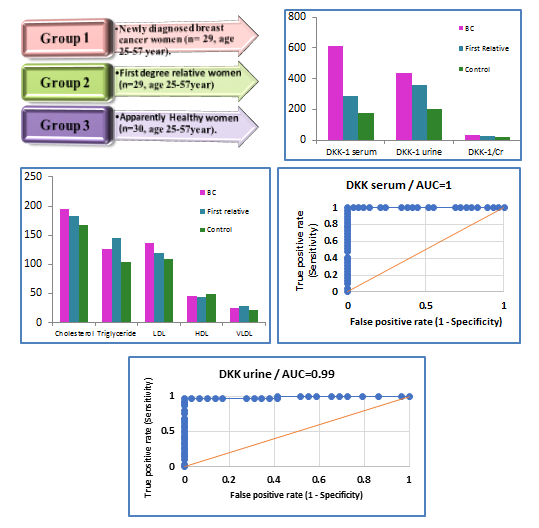
Invasive ductal carcinomas account for approximately 70%–80% of all breast carcinoma (BC) cases. Dickkopf-1 (DKK-1) is a glycoprotein secreted by the tumour that functions as a negative regulator of Wnt signalling. Various clinical disorders have been linked to the misregulation of Wnt signalling. Several research groups have demonstrated that DKK-1 inhibits the Wnt signalling pathway by forming complexes on the cell surface with low-density lipoprotein receptor-related proteins 5 and 6, rather than directly interacting with Wnt or Frizzled proteins. This project aims to investigate the correlation between serum and urine concentrations of DKK-1 and their relation with lipid profiles in Iraqi women with BC. We compare these findings to those obtained for control and first-degree relative groups and assess whether urine can serve as an alternative to serum for measuring DKK-1 levels. Fasting serum and urine DKK-1 levels, as well as serum lipid profiles, were assessed in 29 patients with BC, 29 first-degree relatives, and 30 age-matched healthy controls. An enzyme-linked immunosorbent assay was employed to measure DKK-1 concentrations in both serum and urine, while the Roche Cobas c111 system was used to analyse urine creatinine and lipid profiles. The concentrations of DKK-1 in urine and serum were significantly higher in patients who BC compared to first-degree relatives and healthy controls (p < 0.01). Total cholesterol and low-density lipoprotein levels in the BC group were elevated compared to the control group, with the first-degree relative group falling in between. Triglyceride and very low-density lipoprotein levels did not show significant differences between the BC and control groups; however, the first-degree relative group had the highest concentrations, which were statistically different from the control group but not from the BC group. high-density lipoprotein concentrations were not significantly different among the three groups (p = 0.093). Receiver operating characteristic curve analysis indicated that the optimal diagnostic thresholds for serum and urine DKK-1 were 196.00 and 270 pg/mL, respectively. These findings suggest that DKK-1 serves as a valuable biomarker for diagnosis and prognosis, as well as a potential treatment option, for BC.
References
Chowdhury, F. A., Islam, M. F., Prova, M. T., Khatun, M., Sharmin, I., Islam, K. M., ... & Rahman, M. M. (2021). Association of hyperlipidemia with breast cancer in Bangladeshi women. Lipids in health and disease, 20(1), 52.
Afzal, S., Hassan, M., Ullah, S., Abbas, H., Tawakkal, F., & Khan, M. A. (2022). Breast cancer; discovery of novel diagnostic biomarkers, drug resistance, and therapeutic implications. Frontiers in molecular biosciences, 9, 783450.
Ahmad, S., Alloubani, A., Abu-Sa’da, R., & Qutaiba, Y. (2022). Breast self-examination: knowledge, practice, and beliefs among females in Jordan. SAGE Open Nursing, 8, 23779608221124517.
Ali, O., & Szabó, A. (2023). Review of Eukaryote Cellular Membrane Lipid Composition, with Special Attention to the Fatty Acids. International Journal of Molecular Sciences, 24(21), 15693.
Arif, S., Samad, F. A., Samad, S. A., Khan, A. R., Khan, A., Zahid, R., and Mushtaq, A. (2020).LIPID PROFILE AND ITS SIGNIFICANCE IN BREAST CANCER. International Journal of Advanced Research, 8:1241-1248.
Azbazdar, Y., Karabicici, M., Erdal, E., & Ozhan, G. (2021). Regulation of Wnt signaling pathways at the plasma membrane and their misregulation in cancer. Frontiers in cell and developmental biology, 9, 631623.
Bhushan, A., Gonsalves, A., & Menon, J. U. (2021). Current state of breast cancer diagnosis, treatment, and theranostics. Pharmaceutics, 13(5), 723.
Castagnoli, L., Tagliabue, E., & Pupa, S. M. (2020). Inhibition of the Wnt signalling pathway: An avenue to control breast cancer aggressiveness. International Journal of Molecular Sciences, 21(23), 9069.
Chen, C., Guan, J., Gu, X., Chu, Q., & Zhu, H. (2022). Prostaglandin E2 and receptors: Insight into tumorigenesis, tumor progression, and treatment of hepatocellular carcinoma. Frontiers in Cell and Developmental Biology, 10, 834859.
Chowdhury, F. A., Islam, M. F., Prova, M. T., Khatun, M., Sharmin, I., Islam, K. M., ... & Rahman, M. M. (2021). Association of hyperlipidemia with breast cancer in Bangladeshi women. Lipids in health and disease, 20(1), 52.
Chu, H. Y., Chen, Z., Wang, L., Zhang, Z. K., Tan, X., Liu, S., ... & Zhang, G. (2021). Dickkopf-1: A promising target for cancer immunotherapy. Frontiers in Immunology, 12, 658097.
De Winter, T. J., and Nusse, R. (2021). Running against the Wnt: How Wnt/β-catenin suppresses adipogenesis. Frontiers in cell and developmental biology,9: 627429..
Fernández-Friera, L., Fuster, V., López-Melgar, B., Oliva, B., García-Ruiz, J. M., Mendiguren, J., ... & Sanz, J. (2017). Normal LDL-cholesterol levels are associated with subclinical atherosclerosis in the absence of risk aspects. Journal of the American College of Cardiology, 70(24), 2979-2991.
Forget, M. A., Turcotte, S., Beauseigle, D., Godin-Ethier, J., Pelletier, S., Martin, J., ... & Lapointe, R. (2007). The Wnt pathway regulator DKK1 is preferentially expressed in hormone-resistant breast tumours and in some common cancer types. British journal of cancer, 96(4), 646-653.
Iraqi cancer board, iqcaboard@moh.gov.iq.
Jaiswal, S., & Ayyannan, S. R. (2021). Anticancer Potential of Small‐Molecule Inhibitors of Fatty Acid Amide Hydrolase and Monoacylglycerol Lipase. ChemMedChem, 16(14), 2172-2187.
Jung, S. M., Kang, D., Guallar, E., Yu, J., Lee, J. E., Kim, S. W., Nam, S. J., Cho, J., and Lee, S. K. (2020). Impact of sera lipid on breast cancer recurrence. Journal of Clinical Medicine, 9(9): 2846.
Kolb, R., & Zhang, W. (2020). Obesity and breast cancer: a case of inflamed adipose tissue. Cancers, 12(6), 1686.
Kumie, G., Melak, T., and Baynes, H. W. (2020). The association of sera lipid levels with breast cancer risks among women with breast cancer at felege hiwot comprehensive specialized hospital, Northwest Ethiopia. Breast Cancer: Targets and Therapy, 12:279-287.
Liu, J., Xiao, Q., Xiao, J., Niu, C., Li, Y., Zhang, X., ... & Yin, G. (2022). Wnt/β-catenin signalling: function, biological mechanisms, and therapeutic opportunities. Signal transduction and targeted therapy, 7(1), 3.
Zhu, G., Song, J., Chen, W., Yuan, D., Wang, W., Chen, X., ... & Zhu, J. (2021). Expression and role of Dickkopf-1 (Dkk1) in tumors: from the cells to the patients. Cancer Management and Research, 659-675.
Liu, Y., Tang, W., Xie, L., Wang, J., Deng, Y., Peng, Q., ... & Qin, X. (2014). Prognostic significance of dickkopf-1 overexpression in solid tumors: a meta-analysis. Tumor Biology, 35, 3145-3154.
Longo, M., Zatterale, F., Naderi, J., Parrillo, L., Formisano, P., Raciti, G. A., ... & Miele, C. (2019). Adipose tissue dysfunction as determinant of obesity-associated metabolic complications. International journal of molecular sciences, 20(9), 2358.
Mazon, M., Masi, D., & Carreau, M. (2016). Modulating Dickkopf-1: a strategy to monitor or treat cancer?. Cancers, 8(7), 62.
Mohammed, A. A., Mahmoud, H. Q., & Mhana, R. S. (2023). Advances in the diagnosis and management of breast cancer: a systematic review. World, 2(6).
Nelson, E. R., Chang, C. Y., & McDonnell, D. P. (2014). Cholesterol and breast cancer pathophysiology. Trends in Endocrinology & Metabolism, 25(12), 649-655.
Norman, G. (2010). Likert scales, levels of measurement and the “laws” of statistics. Advances in health sciences education, 15, 625-632.
Darwish, N. M., Al-Hail, M. K., Mohamed, Y., Al Saady, R., Mohsen, S., Zar, A., ... & Pedersen, S. (2023). The Role of Apolipoproteins in the Commonest Cancers: A Review. Cancers, 15(23), 5565.
Olabumuyi, A.A., Abdus-Salam, A. A., Ogunnorin, B. O., and Kuti, M. A. (2021). Lipid profile in breast cancer patients: A case-control study done at a public tertiary hospital in Ibadan Nigeria. Nigerian Journal of Medicine, 30(5): 519-525.
Pandeya, D. R., Rajbhandari, A., Nepal, M., Abdalhabib, E. K., Bhatta ,M., Sen, M. S., Upadhyay, L., and Al Dahr, M. H. S. (2018). Comparative study of sera lipid profiles in nepalese cancer patients attending a tertiary care hospital. The Asian Pacific Journal of Cancer Prevention, 19(2):491-495.
Perugorria, M. J., Olaizola, P., Labiano, I., Esparza-Baquer, A., Marzioni, M., Marin, J. J., ... & Banales, J. M. (2019). Wnt–β-catenin signalling in liver development, health and disease. Nature reviews Gastroenterology & hepatology, 16(2), 121-136.
Reinhold, S., Blankesteijn, W. M., & Foulquier, S. (2020). The interplay of WNT and PPARγ signaling in vascular calcification. Cells, 9(12), 2658.
Santos, D. Z., de Souza, J. C., Pimenta, T. M., Martins, B. S., Junior, R. S. R., Butzene, S. M. S., Tessarolo, N. G., Cilas, P. M. L., Silva, I. V., and Rangel, L. B. (2023). The impact of lipid metabolism on breast cancer: a review about its role in tumorigenesis and immune escape. CCS, 21(1):161.
Shao, Y. C., Wei, Y., Liu, J. F., & Xu, X. Y. (2017). The role of Dickkopf family in cancers: From Bench to Bedside. American journal of cancer research, 7(9), 1754.
Testa, U., Castelli, G., & Pelosi, E. (2020). Breast cancer: a molecularly heterogenous disease needing subtype-specific treatments. Medical Sciences, 8(1), 18.
Zhang, Y., and Wang, X. (2020). Targeting the Wnt/β-catenin signaling pathway in cancer. Journal of hematology & oncology, 13(165):1-16. 3:165.
Stergioti, E. M., Manolakou, T., Boumpas, D. T., & Banos, A. (2022). Antiviral Innate Immune Responses in Autoimmunity: Receptors, Pathways, and Therapeutic Target-ing. Biomedicines 2022, 10, 2820.
Zhu, G., Song, J., Chen, W., Yuan, D., Wang, W., Chen, X., ... & Zhu, J. (2021). Expression and role of Dickkopf-1 (Dkk1) in tumors: from the cells to the patients. Cancer Management and Research, 659-675.
Downloads
Published
Issue
Section
License
Copyright (c) 2025 Malaysian Journal of Science

This work is licensed under a Creative Commons Attribution-NonCommercial 4.0 International License.
Transfer of Copyrights
- In the event of publication of the manuscript entitled [INSERT MANUSCRIPT TITLE AND REF NO.] in the Malaysian Journal of Science, I hereby transfer copyrights of the manuscript title, abstract and contents to the Malaysian Journal of Science and the Faculty of Science, University of Malaya (as the publisher) for the full legal term of copyright and any renewals thereof throughout the world in any format, and any media for communication.
Conditions of Publication
- I hereby state that this manuscript to be published is an original work, unpublished in any form prior and I have obtained the necessary permission for the reproduction (or am the owner) of any images, illustrations, tables, charts, figures, maps, photographs and other visual materials of whom the copyrights is owned by a third party.
- This manuscript contains no statements that are contradictory to the relevant local and international laws or that infringes on the rights of others.
- I agree to indemnify the Malaysian Journal of Science and the Faculty of Science, University of Malaya (as the publisher) in the event of any claims that arise in regards to the above conditions and assume full liability on the published manuscript.
Reviewer’s Responsibilities
- Reviewers must treat the manuscripts received for reviewing process as confidential. It must not be shown or discussed with others without the authorization from the editor of MJS.
- Reviewers assigned must not have conflicts of interest with respect to the original work, the authors of the article or the research funding.
- Reviewers should judge or evaluate the manuscripts objective as possible. The feedback from the reviewers should be express clearly with supporting arguments.
- If the assigned reviewer considers themselves not able to complete the review of the manuscript, they must communicate with the editor, so that the manuscript could be sent to another suitable reviewer.
Copyright: Rights of the Author(s)
- Effective 2007, it will become the policy of the Malaysian Journal of Science (published by the Faculty of Science, University of Malaya) to obtain copyrights of all manuscripts published. This is to facilitate:
- Protection against copyright infringement of the manuscript through copyright breaches or piracy.
- Timely handling of reproduction requests from authorized third parties that are addressed directly to the Faculty of Science, University of Malaya.
- As the author, you may publish the fore-mentioned manuscript, whole or any part thereof, provided acknowledgement regarding copyright notice and reference to first publication in the Malaysian Journal of Science and Faculty of Science, University of Malaya (as the publishers) are given. You may produce copies of your manuscript, whole or any part thereof, for teaching purposes or to be provided, on individual basis, to fellow researchers.
- You may include the fore-mentioned manuscript, whole or any part thereof, electronically on a secure network at your affiliated institution, provided acknowledgement regarding copyright notice and reference to first publication in the Malaysian Journal of Science and Faculty of Science, University of Malaya (as the publishers) are given.
- You may include the fore-mentioned manuscript, whole or any part thereof, on the World Wide Web, provided acknowledgement regarding copyright notice and reference to first publication in the Malaysian Journal of Science and Faculty of Science, University of Malaya (as the publishers) are given.
- In the event that your manuscript, whole or any part thereof, has been requested to be reproduced, for any purpose or in any form approved by the Malaysian Journal of Science and Faculty of Science, University of Malaya (as the publishers), you will be informed. It is requested that any changes to your contact details (especially e-mail addresses) are made known.
Copyright: Role and responsibility of the Author(s)
- In the event of the manuscript to be published in the Malaysian Journal of Science contains materials copyrighted to others prior, it is the responsibility of current author(s) to obtain written permission from the copyright owner or owners.
- This written permission should be submitted with the proof-copy of the manuscript to be published in the Malaysian Journal of Science
Licensing Policy
Malaysian Journal of Science is an open-access journal that follows the Creative Commons Attribution-Non-commercial 4.0 International License (CC BY-NC 4.0)
CC BY – NC 4.0: Under this licence, the reusers to distribute, remix, alter, and build upon the content in any media or format for non-commercial purposes only, as long as proper acknowledgement is given to the authors of the original work. Please take the time to read the whole licence agreement (https://creativecommons.org/licenses/by-nc/4.0/legalcode ).