Effect of Shape on Strength and Durability of Crushed and Uncrushed Quartzite Aggregates from Central Nepal Himalaya
DOI:
https://doi.org/10.22452/mjs.vol44no3.4Keywords:
Quartzite, aggregates, aggregate shape, strength, durabilityAbstract
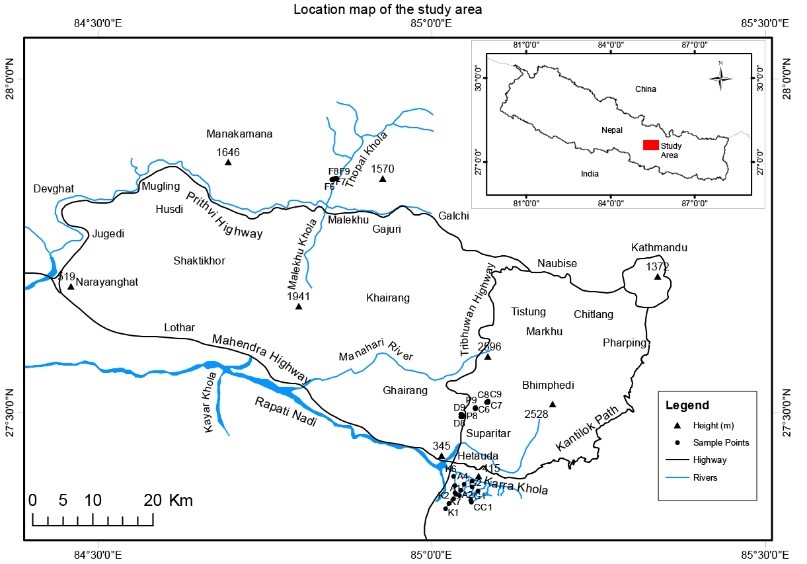
This study examines the influence of shape on the strength and durability of angular (crushed) and rounded (uncrushed) quartzite aggregates sourced from the Central Nepal Himalaya. Crushed quartzite samples, characterized by angular morphologies, exhibit enhanced interlocking and greater variability in mechanical properties such as Point Load Strength Index (PLSI), Aggregate Impact Value (AIV), and Aggregate Crushing Value (ACV), due to their rough textures. In contrast, rounded (uncrushed) quartzite from alluvial gravels, with subrounded particles, demonstrates more consistent strength and durability, as evidenced by narrower ranges in PLSI, AIV, and ACV. Durability tests, including Slake Durability Index (SDI), Los Angeles Abrasion Value (LAAV), and Sulfate Soundness Value (SSV), indicate that angular aggregates provide superior abrasion resistance, whereas subrounded aggregates display more uniform resistance to sulfate-induced weathering. These findings offer valuable insights for selecting quartzite aggregates based on shape to optimize performance in construction applications.
References
Afolagboye, L. O., Talabi, A. O., & Akinola, O. O. (2016). Evaluation of selected basement complex rocks from Ado-Ekiti, SW Nigeria, as source of road construction aggregates. Bulletin of Engineering Geology and the Environment, 75, 853-865.
Ahmad, M., Ansari, M., Sharma, L., Singh, R., & Singh, T. (2017). Correlation between strength and durability indices of rocks-soft computing approach. Procedia Engineering, 191, 458-466.
Aïtcin, P. C. (1998). High performance concrete. CRC Press.
Al-Harthi, A. A. (2001). A field index to determine the strength characteristics of crushed aggregate. Bulletin of Engineering Geology and the Environment, 60, 193-200.
American Concrete Institute. (1991). Standard practice for selecting proportions for normal, heavyweight, and mass concrete (ACI 211.1-91). American Concrete Institute. Retrieved from http://civilwares.free.fr/ACI/MCP04/2211r_98.pdf
American Concrete Institute. (1996). Guide for use of normal weight and heavyweight aggregates in concrete (ACI 221R-96). American Concrete Institute. Retrieved from http://dl.mycivil.ir/dozanani/ACI/ACI%20221R-96%20R01%20Guide%20for%20Use%20of%20Normal%20Weight%20and%20Heavyweight%20Aggregates%20in%20Concrete_MyCivil.ir.pdf
ASTM, A. (2009). C535-09 Standard Test Method for Resistance to Degradation of Large Size Coarse Aggregate by Abrasion and Impact in the Los Angeles Machine. ASTM International, West Conshohocken, PA.
ASTM, D. (2002). 5731. Standard Test Method for Determination of the Point Load Strength Index of Rock and Application to Rock Strength Classifications. ASTM International, West Conshohocken, PA, USA.
ASTM, D. (2008). 4644; Standard Test Method for Slake Durability of Shales and Other Similar Weak Rocks. ASTM International, West Conshohocken, PA, USA.
ASTM. (2005). Standard Test Method for Soundness of Aggregates by Use of Sodium Sulfate or Magnesium Sulfate. ASTM C88-05. ASTM International, West Conshohocken, PA.
Bell, F.G. (2007). Engineering Geology. Butterworth-Heinemann, Oxford, UK, p. 581.
Bista, K., & Tamrakar, N. K. (2015). Evaluation of strength and durability of rocks from Malekhu-Thopal Khola area, Central Nepal Lesser Himalaya for construction aggregates. Bulletin of the Department of Geology, 18, 15-34.
Brattli, B. (1992). The influence of geological factors on the mechanical properties of basic igneous rocks used as road surface aggregates. Engineering Geology, 33(1), 31-44.
British Standards Institution. (1990). Testing aggregates — Part 110: Methods for determination of aggregate crushing value (ACV) (BS 812-110). British Standards Institution.
British Standards Institution. (1990). Testing aggregates — Part 112: Methods for determination of aggregate impact value (AIV) (BS 812-112). British Standards Institution.
BS. (1990). Methods of determination of particle shape. BS 812 105.1, BSI, Flakiness index London. pp. 1–10.
BS. (1990). Testing aggregates Part 105. Methods for determination of particle shape. BS 812 105.2, Elongation index, London, pp. 1-12.
Dhakal, G. P., Kodama, J., & Goto, T. (2006). Freezing-Thawing effect and slake durability of some rocks from cold regions of Nepal and Japan. Journal of Nepal Geological Society, 33, 45-54.
Dhir, R. K., Ramsay, D. M., & Balfour, N. (1971). Study of the aggregate impact and crushing value tests.
Erguler, Z., & Ulusay, R. (2009). Assessment of physical disintegration characteristics of clay-bearing rocks: Disintegration index test and a new durability classification chart. Engineering Geology, 105(1-2), 11-19.
Ersoz, F. (2024). The influence of rock particle shape on slake durability. Journal of Geological Engineering, 12(3), 45-60.
Fairhurst, C. E., & Hudson, J. A. (1999). Draft ISRM suggested method for the complete stress-strain curve for intact rock in uniaxial compression. International Journal of Rock Mechanics and Mining Sciences, 36(3), 279-289.
Gautam, P., & Rösler, W. (1999). Depositional chronology and fabric of Siwalik Group sediments in central Nepal from magnetostratigraphy and magnetic anisotropy. Journal of Asian Earth Sciences, 17(5-6), 659-682.
Gautam, T.P., & Shakoor, A. (2013). Slaking behavior of clay-bearing rocks during a one-year exposure to natural climatic conditions. Engineering Geology, 166, 17-25.
Gökceoğlu, C., Ulusay, R., & Sönmez, H. (2000). Factors affecting the durability of selected weak and clay-bearing rocks from Turkey, with particular emphasis on the influence of the number of drying and wetting cycles. Engineering Geology, 57(3-4), 215-237.
Goodman, P.S. (1980). Gamble’s slake durability classification. In: Perry, E. (Ed.), Proceedings of the 6th International Congress of the International Association of Engineering Geology, Pergamon Press, Oxford, UK, 331-334.
Goswami, S. C. (1984). Influence des facteurs géologiques sur la qualité et la résistance à l'abrasion des granulats pour couches de surface des chaussées. Bulletin of the International Association of Engineering Geology, 30, 59-61.
Gupta, V., & Sharma, R. (2012). Relationship between textural, petrophysical and mechanical properties of quartzites: a case study from northwestern Himalaya. Engineering Geology, 135, 1-9.
Hachani, M. I., Kriker, A., & Seghiri, M. (2017). Experimental study and comparison between the use of natural and artificial course aggregate in concrete mixture. Energy Procedia, 119, 182–191. doi:10.1016/j.egypro.2017.07.067
Hagen, T. (1969). Report on the geological survey of Nepal, vol. 1. Denkschr. Schwez Naturf. Gesell. Bd., 86(1), 1-185.
Hopkins, T. C., & Deen, R. C. (1984). Identification of shales. Geotechnical Testing Journal, 7(1), 10-18.
Hoskins, J. R., & Horino, F. G. (1968). Effect of end conditions on determining compressive strength of rock samples (Vol. 7171). US Department of the Interior, Bureau of Mines.
International Society for Rock Mechanics. (1981). Rock characterization, testing & monitoring: ISRM suggested methods (E. T. Brown, Ed.). Pergamon Press.
Itihara, M., Shibasaki, T., & Miyamoto, N. (1972). Photogeological survey of the Siwalik Ranges and the Terrai Plain. Southeastern Nepal. Jour. 0/Geosciences, Osaka City Univ, 15(4), 77-98.
Kazi, A., & Al-Mansour, Z. R. (1980). Influence of geological factors on abrasion and soundness characteristics of aggregates. Engineering Geology, 15(3-4), 195-203.
Khanal, S., & Tamrakar, N. K. (2009). Evaluation of quality of crushed limestone and-siltstone for road aggregates. Bulletin of Department of Geology, 12, 20-42.
Kimura, K. (1994). Formation and deformation of river terraces in the Hetauda Dum, Central Nepal a Contribution to the Study of Post Siwalikan Tectonics (Doctoral dissertation, Tohoku University).
Kolay, E., & Kayabali, K. (2006). Investigation of the effect of aggregate shape and surface roughness on the slake durability index using the fractal dimension approach. Engineering Geology, 86(4), 271-284.
Koukis, G., Sabatakakis, N., & Spyropoulos, A. (2007). Resistance variation of low-quality aggregates. Bulletin of Engineering Geology and the Environment, 66, 457-466.
Kuna, E., & Bögöly, G. (2024). Overview of mechanical degradation of aggregates, related standards, and the empirical relations of the parameters. Bulletin of Engineering Geology and the Environment, 83(7), 274.
Lees, G., & Kennedy, C. K. (1975). Quality, shape and degradation of aggregates. Quarterly Journal of Engineering Geology and Hydrogeology, 8(3), 193-209.
Maharjan, S., & Tamrakar, N. (2007). Study of Gravel of the Narayani and Rapti River for Construction Materials. Bulletin of Department of Geology, TU, 10, 99-106.
Mehta, P. K., & Monteiro, P. (2006). Concrete: microstructure, properties, and materials (4th ed.). New York: McGraw-Hill Education.
Moon, V. G., & Beattie, A. G. (1995). Textural and microstructural influences on the durability of Waikato coal measures mudrocks. Quarterly Journal of Engineering Geology and Hydrogeology, 28(3), 303-312.
Neville, A. M. (2011). Properties of Concrete, Pearson Education Limited. Edinburgh Gate, Harlow England, 58-661.
Neville, A. M., & Brooks, J. J. (2015). Concrete technology (2nd ed.). Pearson Education Limited.
Podnicks, E. R., Camberlain, P. G., & Thill, R. E. (1968, May). Environmental effects on rock properties. In ARMA US Rock Mechanics/Geomechanics Symposium (pp. ARMA-68). ARMA.
Ramsay, D. M., Dhir, R. K., & Spence, I. M. (1974). The role of rock and clast fabric in the physical performance of crushed-rock aggregate. Engineering Geology, 8(3), 267-285.
Richardson, D. N. (1991). Review of variables that influence measured concrete compressive strength. Journal of Materials in Civil Engineering, 3(2), 95-112.
Schelling, D., Cater, J., Seago, R., & Ojha, T. P. (1991). A balanced cross-section across the Central Nepal Siwalik Hills; Hitauda to Amlekhganj. 北海道大学理学部紀要, 23(1), 1-9.
Smith, M. R., & Collis, L. (2001, January). Aggregates: sand, gravel and crushed rock aggregates for construction purposes. Geological Society of London.
Štambuk Cvitanović, N., Nikolić, M., & Ibrahimbegović, A. (2015). Influence of specimen shape deviations on uniaxial compressive strength of limestone and similar rocks. International Journal of Rock Mechanics and Mining Sciences, 80, 357-372.
Stöcklin, J. (1980). Geology of Nepal and its regional frame: Thirty-third William Smith Lecture. Journal of the Geological Society, 137(1), 1-34.
Stöcklin, J., & Bhattarai, K.D. (1977). Geology of Kathmandu Area and Central Mahabharat Range Nepal. Department of Mines and Geology Kathmandu, Nepal, 86p.
Tamrakar, N. K., Yokota, S., & Shrestha, S. D. (2003). Petrography of the Siwalik sandstones, Amlekhganj-Suparitar area, central Nepal Himalaya. Journal of Nepal Geological Society, 28, 41.
Taylor, R. K. (1988). Coal Measures mudrocks: composition, classification and weathering processes. Quarterly Journal of Engineering Geology and Hydrogeology, 21(1), 85-99.
West, R. M., & Munthe, J. E. N. S. (1981). Cenozoic vertebrate palaeontology and stratigraphy of Nepal. Himalayan Geology, 11, 18-27.
Downloads
Published
Issue
Section
License
Copyright (c) 2025 Malaysian Journal of Science

This work is licensed under a Creative Commons Attribution-NonCommercial 4.0 International License.
Transfer of Copyrights
- In the event of publication of the manuscript entitled [INSERT MANUSCRIPT TITLE AND REF NO.] in the Malaysian Journal of Science, I hereby transfer copyrights of the manuscript title, abstract and contents to the Malaysian Journal of Science and the Faculty of Science, University of Malaya (as the publisher) for the full legal term of copyright and any renewals thereof throughout the world in any format, and any media for communication.
Conditions of Publication
- I hereby state that this manuscript to be published is an original work, unpublished in any form prior and I have obtained the necessary permission for the reproduction (or am the owner) of any images, illustrations, tables, charts, figures, maps, photographs and other visual materials of whom the copyrights is owned by a third party.
- This manuscript contains no statements that are contradictory to the relevant local and international laws or that infringes on the rights of others.
- I agree to indemnify the Malaysian Journal of Science and the Faculty of Science, University of Malaya (as the publisher) in the event of any claims that arise in regards to the above conditions and assume full liability on the published manuscript.
Reviewer’s Responsibilities
- Reviewers must treat the manuscripts received for reviewing process as confidential. It must not be shown or discussed with others without the authorization from the editor of MJS.
- Reviewers assigned must not have conflicts of interest with respect to the original work, the authors of the article or the research funding.
- Reviewers should judge or evaluate the manuscripts objective as possible. The feedback from the reviewers should be express clearly with supporting arguments.
- If the assigned reviewer considers themselves not able to complete the review of the manuscript, they must communicate with the editor, so that the manuscript could be sent to another suitable reviewer.
Copyright: Rights of the Author(s)
- Effective 2007, it will become the policy of the Malaysian Journal of Science (published by the Faculty of Science, University of Malaya) to obtain copyrights of all manuscripts published. This is to facilitate:
- Protection against copyright infringement of the manuscript through copyright breaches or piracy.
- Timely handling of reproduction requests from authorized third parties that are addressed directly to the Faculty of Science, University of Malaya.
- As the author, you may publish the fore-mentioned manuscript, whole or any part thereof, provided acknowledgement regarding copyright notice and reference to first publication in the Malaysian Journal of Science and Faculty of Science, University of Malaya (as the publishers) are given. You may produce copies of your manuscript, whole or any part thereof, for teaching purposes or to be provided, on individual basis, to fellow researchers.
- You may include the fore-mentioned manuscript, whole or any part thereof, electronically on a secure network at your affiliated institution, provided acknowledgement regarding copyright notice and reference to first publication in the Malaysian Journal of Science and Faculty of Science, University of Malaya (as the publishers) are given.
- You may include the fore-mentioned manuscript, whole or any part thereof, on the World Wide Web, provided acknowledgement regarding copyright notice and reference to first publication in the Malaysian Journal of Science and Faculty of Science, University of Malaya (as the publishers) are given.
- In the event that your manuscript, whole or any part thereof, has been requested to be reproduced, for any purpose or in any form approved by the Malaysian Journal of Science and Faculty of Science, University of Malaya (as the publishers), you will be informed. It is requested that any changes to your contact details (especially e-mail addresses) are made known.
Copyright: Role and responsibility of the Author(s)
- In the event of the manuscript to be published in the Malaysian Journal of Science contains materials copyrighted to others prior, it is the responsibility of current author(s) to obtain written permission from the copyright owner or owners.
- This written permission should be submitted with the proof-copy of the manuscript to be published in the Malaysian Journal of Science
Licensing Policy
Malaysian Journal of Science is an open-access journal that follows the Creative Commons Attribution-Non-commercial 4.0 International License (CC BY-NC 4.0)
CC BY – NC 4.0: Under this licence, the reusers to distribute, remix, alter, and build upon the content in any media or format for non-commercial purposes only, as long as proper acknowledgement is given to the authors of the original work. Please take the time to read the whole licence agreement (https://creativecommons.org/licenses/by-nc/4.0/legalcode ).