Policy Elements Influencing the Sustainability of the Biosimilar Market in Malaysia: A Review
DOI:
https://doi.org/10.22452/mjs.vol44sp1.2Keywords:
biosimilars market Malaysia, sustainability, biosimilars policy, biosimilar regulatory guidelines, literature reviewAbstract
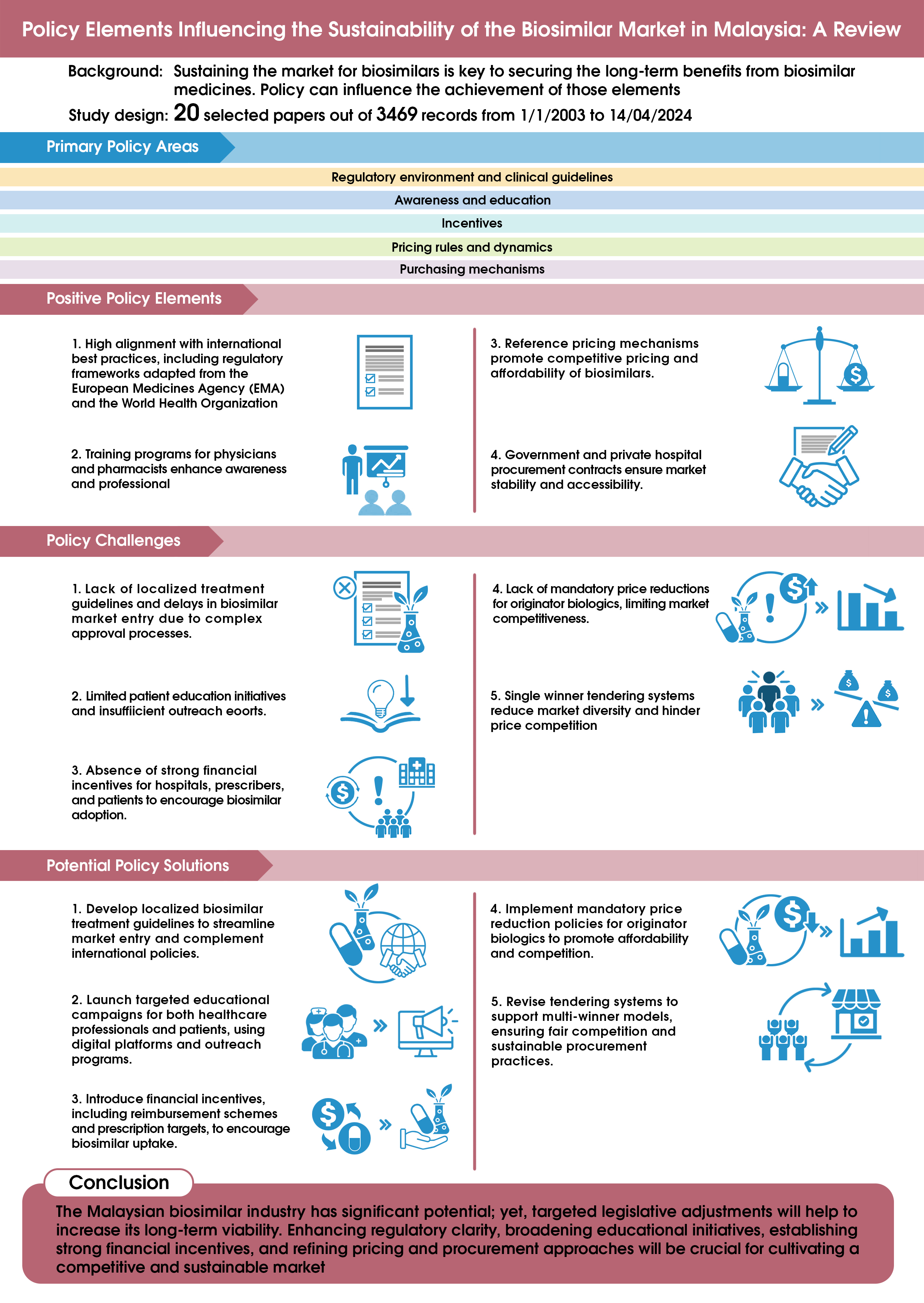
Sustaining the market for biosimilars is key to securing the long-term benefits from biosimilar medicines. Policy can influence the achievement of those elements that contribute to the sustainability of biosimilars. Despite being the first country to implement regulatory guidelines for the approval and marketing of biosimilars, the availability and adoption of biosimilars in Malaysia remain suboptimal. This study aims to create the roadmap of policy elements that influence the sustainability of the biosimilar market in Malaysia. The study searched and reviewed articles in PubMed, Google Scholar, National Library of Medicine from 1/1/2003 to 14/04/2024. A total of 3469 results were found, with PubMed contributing 39 records (n=39), Google Scholar contributing 3074 records (n=3074), and the National Library of Medicine contributing 356 records (n=356). The biosimilars policy framework and sustainability measures were adopted from IQVIA Country Scorecards for Biosimilar Sustainability. After eliminating duplicates and applying selection criteria, 20 articles were chosen for review. The selection was justified based on relevance to the five policy domains: regulatory environment and clinical guidelines, awareness and education, incentives, pricing rules and dynamics, and purchasing mechanisms. The 20 selected papers were categorized into five main domains: regulatory environment and clinical guidelines, awareness and education, incentives, pricing rules and dynamics, and purchasing mechanisms. The analysis revealed positive developments in regulatory compliance and clinical guidelines, pricing regulations, and purchasing mechanisms. However, challenges were identified in the areas of awareness and education, pricing rules and dynamics, and incentives. Awareness and education challenges were primarily attributed to limited pharmacist training and physician skepticism regarding biosimilars. Additionally, the absence of strong financial incentives and limited patient education hindered adoption. The "single-winner tendering system" constrained market diversity, restricting competitive pricing. The literature review emphasizes the need for setting up specific prescription targets, promoting competition, and offering incentives to biosimilar manufacturers to increase market appeal. Furthermore, it is critical to enforce strict quality standards for the incorporation of tenders and align the registration requirements with global standards. Education for pharmacists and continuous training for healthcare practitioners are also essential. In Malaysia, these steps are crucial in ensuring the affordability and accessibility of biosimilars. Improving these policy components could help Malaysia create a competitive biosimilar market, increase access to affordable treatments, and eventually raise the standard of healthcare service.
References
Abas, A. (2011). Regulatory guidelines for biosimilars in Malaysia. Biologicals, 39(5), 339–342. https://doi.org/10.1016/j.biologicals.2011.06.009
Advancing Biosimilar Sustainability in Europe—IQVIA. (2018). https://www.iqvia.com/insights/the-iqvia-institute/reports-and-publications/reports/advancing-biosimilar-sustainability-in-europe
Alnaqbi, K. A., Bellanger, A., Brill, A., Castañeda-Hernández, G., Clopés Estela, A., Delgado Sánchez, O., García-Alfonso, P., Gyger, P., Heinrich, D., Hezard, G., Kakehasi, A., Koehn, C., Mariotte, O., Mennini, F., Mayra Pérez-Tapia, S., Pistollato, M., Saada, R., Sasaki, T., Tambassis, G., … Simoens, S. (2023). An international comparative analysis and roadmap to sustainable biosimilar markets. Frontiers in Pharmacology, 14. https://doi.org/10.3389/fphar.2023.1188368
Arianna Bertolani, & Claudio Jommi. (2020). Local policies on biosimilars: Are they designed to optimize use of liberated resources? - GaBI Journal. https://gabi-journal.net/local-policies-on-biosimilars-are-they-designed-to-optimize-use-of-liberated-resources.html
Barbier, L., Vandenplas, Y., Simoens, S., Declerck, P., Vulto, A. G., & Huys, I. (2021). Knowledge and perception of biosimilars in ambulatory care: A survey among Belgian community pharmacists and physicians. Journal of Pharmaceutical Policy and Practice, 14(1), 53. https://doi.org/10.1186/s40545-021-00330-x
Barbier, L., & Vulto, A. G. (2021). Interchangeability of Biosimilars: Overcoming the Final Hurdles. Drugs, 81(16), 1897–1903. https://doi.org/10.1007/s40265-021-01629-4
Bas, T. G., & Oliu Castillo, C. (2016). Biosimilars in Developed and Developing East and Southeast Asian Countries: Japan, South Korea, and Malaysia—Overview, Evolution, and Regulations Assessment. BioMed Research International, 2016, e5910403. https://doi.org/10.1155/2016/5910403
Baumgart, D., Misery, L., Naeyaert, S., & Taylor, P. (2019). Biological Therapies in Immune-Mediated Inflammatory Diseases: Can Biosimilars Reduce Access Inequities?Table_1.DOCX. Frontiers in Pharmacology, 10. https://doi.org/10.3389/fphar.2019.00279
Bond, A. M., Dean, E. B., & Desai, S. M. (2023). The Role Of Financial Incentives In Biosimilar Uptake In Medicare: Evidence From The 340B Program. Health Affairs, 42(5), 632–641. https://doi.org/10.1377/hlthaff.2022.00812
Cazap, E., Jacobs, I., McBride, A., Popovian, R., & Sikora, K. (2018). Global Acceptance of Biosimilars: Importance of Regulatory Consistency, Education, and Trust. The Oncologist, 23(10), 1188–1198. https://doi.org/10.1634/theoncologist.2017-0671
Chen, H.-H., Yemeke, T., & Ozawa, S. (2024). Reduction of biologic pricing following biosimilar introduction: Analysis across 57 countries and regions, 2012–19. PLOS ONE, 19(6), e0304851. https://doi.org/10.1371/journal.pone.0304851
Chong, S. C., Rajah, R., Chow, P. L., Tan, H. C., Chong, C. M., Khor, K. Y., Lee, W. P., & Tan, W. Y. (2022). Perspectives toward biosimilars among oncologists: A Malaysian survey. Journal of Oncology Pharmacy Practice: Official Publication of the International Society of Oncology Pharmacy Practitioners, 10781552221104773. https://doi.org/10.1177/10781552221104773
Chopra, R., & Lopes, G. (2017). Improving Access to Cancer Treatments: The Role of Biosimilars. Journal of Global Oncology, 3(5), 596–610. https://doi.org/10.1200/JGO.2016.008607
EIU. (2005). Economic and Business Conditions Globally. http://graphics.eiu.com/files/ad_pdfs/2005ereadiness_ranking_wp.pdf
EMEA. (2014). Guideline on similar biological medicinal products containing biotechnology-derived proteins as active substance: Quality issues (revision 1). https://www.ema.europa.eu/en/documents/scientific-guideline/guideline-similar-biological-medicinal-products-containing-biotechnology-derived-proteins-active-substance-quality-issues-revision-1_en.pdf
EMEA. (2023). Biosimilar medicines: Overview | European Medicines Agency. https://www.ema.europa.eu/en/human-regulatory-overview/biosimilar-medicines-overview
Fischer, F., Lange, K., Klose, K., Greiner, W., & Kraemer, A. (2016). Barriers and Strategies in Guideline Implementation—A Scoping Review. Healthcare, 4(3), 36. https://doi.org/10.3390/healthcare4030036
Godman, B., Fadare, J., Kwon, H.-Y., Dias, C. Z., Kurdi, A., Dias Godói, I. P., Kibuule, D., Hoxha, I., Opanga, S., Saleem, Z., Bochenek, T., Marković-Peković, V., Mardare, I., Kalungia, A. C., Campbell, S., Allocati, E., Pisana, A., Martin, A. P., & Meyer, J. C. (2021). Evidence-based public policy making for medicines across countries: Findings and implications for the future. Journal of Comparative Effectiveness Research, 10(12), 1019–1052. https://doi.org/10.2217/cer-2020-0273
Godman, B., Haque, M., Kumar, S., Islam, S., Charan, J., Akter, F., Kurdi, A., Allocati, E., Bakar, M. A., Rahim, S. A., Sultana, N., Deeba, F., Halim Khan, M. A., Alam, A. B. M. M., Jahan, I., Kamal, Z. M., Hasin, H., Munzur-E-Murshid, null, Nahar, S., … Jakovljevic, M. (2021). Current utilization patterns for long-acting insulin analogues including biosimilars among selected Asian countries and the implications for the future. Current Medical Research and Opinion, 37(9), 1529–1545. https://doi.org/10.1080/03007995.2021.1946024
Godman, B., Haque, M., Leong, T., Allocati, E., Kumar, S., Islam, S., Charan, J., Akter, F., Kurdi, A., Vassalo, C., Bakar, M. A., Rahim, S. A., Sultana, N., Deeba, F., Khan, M. A. H., Alam, A. B. M. M., Jahan, I., Kamal, Z. M., Hasin, H., … Jakovljevic, M. (2021). The Current Situation Regarding Long-Acting Insulin Analogues Including Biosimilars Among African, Asian, European, and South American Countries; Findings and Implications for the Future. Frontiers in Public Health, 9. https://doi.org/10.3389/fpubh.2021.671961
Godman, B., Wladysiuk, M., McTaggart, S., Kurdi, A., Allocati, E., Jakovljevic, M., Kalemeera, F., Hoxha, I., Nachtnebel, A., Sauermann, R., Hinteregger, M., Marković-Peković, V., Tubic, B., Petrova, G., Tachkov, K., Slabý, J., Nejezchlebova, R., Krulichová, I. S., Laius, O., … Wettermark, B. (2021). Utilisation Trend of Long-Acting Insulin Analogues including Biosimilars across Europe: Findings and Implications. BioMed Research International, 2021, 9996193. https://doi.org/10.1155/2021/9996193
Hamzah, N., Perera, P. N., & Rannan-Eliya, R. P. (2020). How well does Malaysia achieve value for money in public sector purchasing of medicines? Evidence from medicines procurement prices from 2010 to 2014. BMC Health Services Research, 20(1), 509. https://doi.org/10.1186/s12913-020-05362-8
Hoang, N. T. M., Fatokun, O., & Farrukh, M. J. (2024). Biosimilar drug lag and evolution in Malaysia: A retrospective analysis of regulatory approvals. Journal of Applied Pharmaceutical Science. https://doi.org/10.7324/JAPS.2025.199198
IQVIA. (2020). Country Scorecards for Biosimilar Sustainability—IQVIA. https://www.iqvia.com/insights/the-iqvia-institute/reports-and-publications/reports/country-scorecards-for-biosimilar-sustainability
Itoshima, H., Takada, D., Goto, E., Sasaki, N., Kunisawa, S., & Imanaka, Y. (2024). The impact of financial incentives promoting biosimilar products in oncology: A quasi-experimental study using administrative data. PLOS ONE, 19(11), e0312577. https://doi.org/10.1371/journal.pone.0312577
Kananatu. (2002). Healthcare Financing in Malaysia. Asia Pacific Journal of Public Health, 14(1), 23-28. https://doi.org/10.1177/101053950201400106
Kang, H.-N., Thorpe, R., Knezevic, I., Blades, C. D. R. Z., Casas Levano, M., Chew, J. Y., Chilufya, M. B., Chirachanakul, P., Chua, H. M., Farahani, A. V., Ghobrial, M. R. W., Habahbeh, S., Hamel, H., Kim, G. H., Perez Rodriguez, V., Putri, D. E., Rodgers, J., Savkina, M., Semeniuk, O., … Yamaguchi, T. (2020). The regulatory landscape of biosimilars: WHO efforts and progress made from 2009 to 2019. Biologicals, 65, 1–9. https://doi.org/10.1016/j.biologicals.2020.02.005
Kang, H.-N., Thorpe, R., Knezevic, I., Casas Levano, M., Chilufya, M. B., Chirachanakul, P., Chua, H. M., Dalili, D., Foo, F., Gao, K., Habahbeh, S., Hamel, H., Kim, G. H., Perez Rodriguez, V., Putri, D. E., Rodgers, J., Savkina, M., Semeniuk, O., Srivastava, S., … Yamaguchi, T. (2021). Regulatory challenges with biosimilars: An update from 20 countries. Annals of the New York Academy of Sciences, 1491(1), 42–59. https://doi.org/10.1111/nyas.14522
Khan, H. N., Razali, R. B., & Shafie, A. B. (2016). Modeling Determinants of Health Expenditures in Malaysia: Evidence from Time Series Analysis. Frontiers in Pharmacology, 7. https://doi.org/10.3389/fphar.2016.00069
Khean, D. K. Y. (2014, November 25). Value Based Medicines & Access: The Balancing Act – KKM. The Malaysian Medical Gazette. https://www.mmgazette.com/value-based-medicines-access-the-balancing-act-kkm/
Khoo, Y. S. K., Tang, T. Y., Goh, P. S., Halimi, H. M., & Ab Ghani, A. (2017a). An Update on the Registration of Biosimilars in Malaysia. Therapeutic Innovation & Regulatory Science, 51(1), 55–59. https://doi.org/10.1177/2168479016664774
Laurisz, N., Ćwiklicki, M., Żabiński, M., Canestrino, R., & Magliocca, P. (2023). The Stakeholders’ Involvement in Healthcare 4.0 Services Provision: The Perspective of Co-Creation. International Journal of Environmental Research and Public Health, 20(3), 2416. https://doi.org/10.3390/ijerph20032416
Leonard, E., Wascovich, M., Oskouei, S., Gurz, P., & Carpenter, D. (2019). Factors Affecting Health Care Provider Knowledge and Acceptance of Biosimilar Medicines: A Systematic Review. Journal of Managed Care & Specialty Pharmacy, 25(1), 102–112. https://doi.org/10.18553/jmcp.2019.25.1.102
Lexchin, J. (2020). Affordable Biologics for All. JAMA Network Open, 3(4), e204753. https://doi.org/10.1001/jamanetworkopen.2020.4753
Lobo, F., & Río-Álvarez, I. (2021). Barriers to Biosimilar Prescribing Incentives in the Context of Clinical Governance in Spain. Pharmaceuticals, 14(3), 283. https://doi.org/10.3390/ph14030283
Makurvet, F. D. (2021). Biologics vs. small molecules: Drug costs and patient access. Medicine in Drug Discovery, 9, 100075. https://doi.org/10.1016/j.medidd.2020.100075
Maniadakis, N., Holtorf, A.-P., Otávio Corrêa, J., Gialama, F., & Wijaya, K. (2018a). Shaping Pharmaceutical Tenders for Effectiveness and Sustainability in Countries with Expanding Healthcare Coverage. Applied Health Economics and Health Policy, 16(5), 591–607. https://doi.org/10.1007/s40258-018-0405-7
Maniadakis, N., Holtorf, A.-P., Otávio Corrêa, J., Gialama, F., & Wijaya, K. (2018b). Shaping Pharmaceutical Tenders for Effectiveness and Sustainability in Countries with Expanding Healthcare Coverage. Applied Health Economics and Health Policy, 16(5), 591–607. https://doi.org/10.1007/s40258-018-0405-7
MOH Malaysia. (2021). Health Expenditure Report. https://www.moh.gov.my/moh/resources/Penerbitan/Penerbitan%20Utama/MNHA/MNHA_Health_Expenditure_Report_1997-2019_02092021.pdf
Mohd Kasim, F., Hatah, E., Osman, L. H., Mhd Ali, A., & Babar, Z.-U.-D. (2024). Analyzing trends and factors influencing price changes in public pooled drugs procurement system in Malaysia: Exploring market competition. Saudi Pharmaceutical Journal, 32(12), 102214. https://doi.org/10.1016/j.jsps.2024.102214
Mohd Sani, N., Aziz, Z., & Kamarulzaman, A. (2023b). Malaysian Hospital Pharmacists’ Perspectives and Their Role in Promoting Biosimilar Prescribing: A Nationwide Survey. BioDrugs: Clinical Immunotherapeutics, Biopharmaceuticals and Gene Therapy, 37(1), 109–120. https://doi.org/10.1007/s40259-022-00571-5
Mohd Sani, N., Aziz, Z., & Kamarulzaman, A. (2024a). Use of Biosimilars: A Systematic Review of Published Position Statements and Recommendations from Health Organisations and Societies. BioDrugs: Clinical Immunotherapeutics, Biopharmaceuticals and Gene Therapy, 38(3), 405–423. https://doi.org/10.1007/s40259-024-00649-2
Mohd Sani, N., Aziz, Z., Panickar, R., & Kamarulzaman, A. (2022a). Pharmacists’ Perspectives of Biosimilars: A Systematic Review. BioDrugs: Clinical Immunotherapeutics, Biopharmaceuticals and Gene Therapy, 36(4), 489–508. https://doi.org/10.1007/s40259-022-00541-x
Moorkens, E., Vulto, A. G., Huys, I., Dylst, P., Godman, B., Keuerleber, S., Claus, B., Dimitrova, M., Petrova, G., Sović-Brkičić, L., Slabý, J., Šebesta, R., Laius, O., Karr, A., Beck, M., Martikainen, J. E., Selke, G. W., Spillane, S., McCullagh, L., … Simoens, S. (2017). Policies for biosimilar uptake in Europe: An overview. PloS One, 12(12), e0190147. https://doi.org/10.1371/journal.pone.0190147
Nahleh, Z., Lyman, G. H., Schilsky, R. L., Peterson, D. E., Tagawa, S. T., Chavez-MacGregor, M., Rumble, R. B., & Gupta, S. (2022). Use of Biosimilar Medications in Oncology. JCO Oncology Practice, 18(3), 177–186. https://doi.org/10.1200/OP.21.00771
Németh, G., Mágó, M. L., Kaló, Z., Lám, J., Balogh, T., & Brodszky, V. (2023). A concept for multi-winner tenders for medicinal products with balancing between efficient prices, long-term competition and sustainability of supply. Frontiers in Medicine, 10, 1282698. https://doi.org/10.3389/fmed.2023.1282698
Pritha Paul, Rahul Kapur, Shivani Mittra, Nimish Shah, Gopal K Rao, & Matthew E Erick. (2024). Increasing adoption of quality-assured biosimilars to address access challenges in low- and middle-income countries—GaBI Journal. https://gabi-journal.net/increasing-adoption-of-quality-assured-biosimilars-to-address-access-challenges-in-low-and-middle-income-countries.html
Rémuzat, C., Kapuśniak, A., Caban, A., Ionescu, D., Radière, G., Mendoza, C., & Toumi, M. (2017). Supply-side and demand-side policies for biosimilars: An overview in 10 European member states. Journal of Market Access & Health Policy, 5(1), 1307315. https://doi.org/10.1080/20016689.2017.1307315
Sani, N., Aziz, Z., & Kamarulzaman, A. (2020). Biosimilars in Malaysia: Regulatory Framework, Approved Products, and Adverse Effects. Therapeutic Innovation & Regulatory Science, 55, 1–13. https://doi.org/10.1007/s43441-020-00243-y
Sani, N. M., McAuslane, N., Kasbon, S. H., Ahmad, R., Yusof, F. A. M., & Patel, P. (2020). An Evaluation of Malaysian Regulatory Process for New Active Substances Approved in 2017 Using the OpERA Methodology. Therapeutic Innovation & Regulatory Science, 54(5), 1215. https://doi.org/10.1007/s43441-020-00140-4
Sarnola, K., Merikoski, M., Jyrkkä, J., & Hämeen-Anttila, K. (2020). Physicians’ perceptions of the uptake of biosimilars: A systematic review. BMJ Open, 10(5), e034183. https://doi.org/10.1136/bmjopen-2019-034183
Shakeel, S., Hassali, M. A., Rehman, H., Rehman, A. U., & Muneswarao, J. (2020a). Knowledge, Attitude, and Practice Towards Biosimilars and Interchangeable Products: A Prescriptive Insight by the Pharmacists. International Journal of General Medicine, 13, 1075–1082. https://doi.org/10.2147/IJGM.S266545
Shakeel, S., Hassali, M. A., Rehman, H., Rehman, A. ur, & Muneswarao, J. (2020b). Knowledge, Attitude, and Practice Towards Biosimilars and Interchangeable Products: A Prescriptive Insight by the Pharmacists. International Journal of General Medicine, 13, 1075–1082. https://doi.org/10.2147/IJGM.S266545
Shubow, S., Sun, Q., Nguyen Phan, A. L., Hammell, D. C., Kane, M., Lyman, G. H., Gibofsky, A., Lichtenstein, G. R., Bloomgarden, Z., Cross, R. K., Yim, S., Polli, J. E., & Wang, Y. (2022). Prescriber Perspectives on Biosimilar Adoption and Potential Role of Clinical Pharmacology: A Workshop Summary. Clinical Pharmacology and Therapeutics, 113(1), 37–49. https://doi.org/10.1002/cpt.2765
Simoens, S., Lacosta, T. B., & Inotai, A. (2024). Learnings from cross-border biosimilar pricing policies in Europe. Expert Review of Pharmacoeconomics & Outcomes Research, 24(5), 585–588. https://doi.org/10.1080/14737167.2024.2334343
Simoens, S., & Vulto, A. G. (2021). A health economic guide to market access of biosimilars. Expert Opinion on Biological Therapy, 21(1), 9–17. https://doi.org/10.1080/14712598.2021.1849132
Su-Lyn, B. (2020, December 31). Psoriasis Patients Willing To Sacrifice Shots Amid Limited Biologics Access. CodeBlue. https://codeblue.galencentre.org/2020/12/31/psoriasis-patients-willing-to-sacrifice-shots-amid-limited-biologics-access/
Thongpooswan, S., Das, A., Patil, P., Latymer, M., Llamado, L., & Wee, J. (2024). Physicians’ and patients’ perception of biosimilars and factors affecting biosimilar prescribing in selected Asian countries: A survey study. Expert Opinion on Biological Therapy, 24(10), 1171–1182. https://doi.org/10.1080/14712598.2024.2400523
Vogler, S., Schneider, P., Zuba, M., Busse, R., & Panteli, D. (2021). Policies to Encourage the Use of Biosimilars in European Countries and Their Potential Impact on Pharmaceutical Expenditure. Frontiers in Pharmacology, 12, 625296. https://doi.org/10.3389/fphar.2021.625296
Wadhwa, M., Kang, H.-N., Thorpe, R., Knezevic, I., following participants of the WHO informal consultation on revision of guidelines on evaluation of similar biotherapeutic products, Aprea, P., Bielsky, M.-C., Ekman, N., Heim, H.-K., Joung, J., Kurki, P., Lacana, E., Njue, C., Nkansah, E., Savkina, M., Thorpe, R., Yamaguchi, T., Wadhwa, M., Wang, J., … WHO Secretariat. (2022). WHO informal consultation on revision of guidelines on evaluation of similar biotherapeutic products, virtual meeting, 30 June—2 July 2021. Biologicals: Journal of the International Association of Biological Standardization, 76, 1–9. https://doi.org/10.1016/j.biologicals.2022.03.001
WHO. (2012). Malaysia Health System Review—IRIS. https://iris.who.int/bitstream/handle/10665/206911/9789290615842_eng.pdf
Yun, W., & Yusoff, R. (2015). An Empirical Study of Education Expenditure, Health Care Expenditure and Economic Growth in Malaysia using Granger Causality Approach. Malaysian Journal of Business and Economics (MJBE), 2, 1–10.
Zamzairee Z.A., & Muhamad Hanafiah Juni. (2019). RISING HEALTHCARE EXPENDITURE – DEMAND SIDE: A SYSTEMATIC REVIEW | Z.A. | International Journal of Public Health and Clinical Sciences. https://publichealthmy.org/ejournal/ojs2/index.php/ijphcs/article/view/969
Downloads
Published
Issue
Section
License
Copyright (c) 2025 Malaysian Journal of Science

This work is licensed under a Creative Commons Attribution-NonCommercial 4.0 International License.
Transfer of Copyrights
- In the event of publication of the manuscript entitled [INSERT MANUSCRIPT TITLE AND REF NO.] in the Malaysian Journal of Science, I hereby transfer copyrights of the manuscript title, abstract and contents to the Malaysian Journal of Science and the Faculty of Science, University of Malaya (as the publisher) for the full legal term of copyright and any renewals thereof throughout the world in any format, and any media for communication.
Conditions of Publication
- I hereby state that this manuscript to be published is an original work, unpublished in any form prior and I have obtained the necessary permission for the reproduction (or am the owner) of any images, illustrations, tables, charts, figures, maps, photographs and other visual materials of whom the copyrights is owned by a third party.
- This manuscript contains no statements that are contradictory to the relevant local and international laws or that infringes on the rights of others.
- I agree to indemnify the Malaysian Journal of Science and the Faculty of Science, University of Malaya (as the publisher) in the event of any claims that arise in regards to the above conditions and assume full liability on the published manuscript.
Reviewer’s Responsibilities
- Reviewers must treat the manuscripts received for reviewing process as confidential. It must not be shown or discussed with others without the authorization from the editor of MJS.
- Reviewers assigned must not have conflicts of interest with respect to the original work, the authors of the article or the research funding.
- Reviewers should judge or evaluate the manuscripts objective as possible. The feedback from the reviewers should be express clearly with supporting arguments.
- If the assigned reviewer considers themselves not able to complete the review of the manuscript, they must communicate with the editor, so that the manuscript could be sent to another suitable reviewer.
Copyright: Rights of the Author(s)
- Effective 2007, it will become the policy of the Malaysian Journal of Science (published by the Faculty of Science, University of Malaya) to obtain copyrights of all manuscripts published. This is to facilitate:
- Protection against copyright infringement of the manuscript through copyright breaches or piracy.
- Timely handling of reproduction requests from authorized third parties that are addressed directly to the Faculty of Science, University of Malaya.
- As the author, you may publish the fore-mentioned manuscript, whole or any part thereof, provided acknowledgement regarding copyright notice and reference to first publication in the Malaysian Journal of Science and Faculty of Science, University of Malaya (as the publishers) are given. You may produce copies of your manuscript, whole or any part thereof, for teaching purposes or to be provided, on individual basis, to fellow researchers.
- You may include the fore-mentioned manuscript, whole or any part thereof, electronically on a secure network at your affiliated institution, provided acknowledgement regarding copyright notice and reference to first publication in the Malaysian Journal of Science and Faculty of Science, University of Malaya (as the publishers) are given.
- You may include the fore-mentioned manuscript, whole or any part thereof, on the World Wide Web, provided acknowledgement regarding copyright notice and reference to first publication in the Malaysian Journal of Science and Faculty of Science, University of Malaya (as the publishers) are given.
- In the event that your manuscript, whole or any part thereof, has been requested to be reproduced, for any purpose or in any form approved by the Malaysian Journal of Science and Faculty of Science, University of Malaya (as the publishers), you will be informed. It is requested that any changes to your contact details (especially e-mail addresses) are made known.
Copyright: Role and responsibility of the Author(s)
- In the event of the manuscript to be published in the Malaysian Journal of Science contains materials copyrighted to others prior, it is the responsibility of current author(s) to obtain written permission from the copyright owner or owners.
- This written permission should be submitted with the proof-copy of the manuscript to be published in the Malaysian Journal of Science
Licensing Policy
Malaysian Journal of Science is an open-access journal that follows the Creative Commons Attribution-Non-commercial 4.0 International License (CC BY-NC 4.0)
CC BY – NC 4.0: Under this licence, the reusers to distribute, remix, alter, and build upon the content in any media or format for non-commercial purposes only, as long as proper acknowledgement is given to the authors of the original work. Please take the time to read the whole licence agreement (https://creativecommons.org/licenses/by-nc/4.0/legalcode ).