Rare Case of High Voltage Electric Injury Resulting in Bowel Perforation: A Successful Management with Diversion Colostomy
DOI:
https://doi.org/10.22452/mjs.vol44sp1.12Keywords:
Electric injury, descending colon perforation, diversion colostomyAbstract
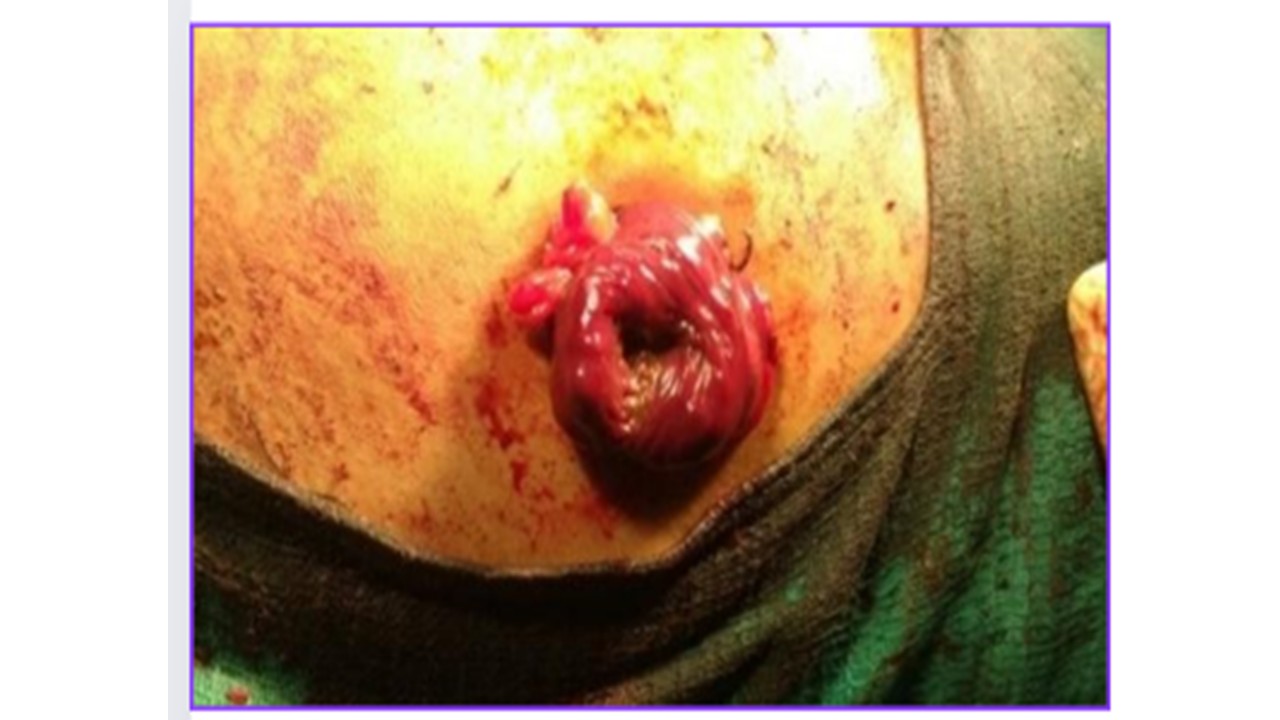
Electrical injuries are categorized into low-voltage injuries (<1 kilovolt) and high-voltage injuries (>1 kilovolt). Electrical injuries usually present with an entry wound at the site of contact and an exit wound where the current leaves the body. Bowel perforation caused by an electric current is a rare but serious complication. We report a case of a high-voltage electric burn with entry wounds on both hands and an exit wound on the right foot, complicated by descending colon perforation, which presented late with peritonitis. The patient was successfully treated with a diversion colostomy and subsequent takedown. This case highlights the potential for significant internal injuries, such as bowel perforation, following high-voltage electrical injuries and emphasizes the importance of timely surgical intervention for such complications.
References
Williams, L. J., Zolfaghari, S., & Boushey, R. P. (2010). Complications of enterocutaneous fistulas and their management. Clinics in Colon and Rectal Surgery, 23(3), 209–220. https://doi.org/10.1055/s-0030-1263062
Lee, R. C. (1997). Injury by electrical forces: Pathophysiology, manifestations, and therapy. Current Problems in Surgery, 34(9), 677–764. https://doi.org/10.1016/S0011-3840(97)80007-X
Haberal, M., Ucar, N., Bayraktar, U., & Oener, R. (1996). Severe complications in electrical burns (including visceral complications). Annals of Burns and Fire Disasters, 9(3), 149–152. http://www.medbc.com/annals/review/vol_9/num_3/text/vol9n3p149.htm
Sharma, M., Kaundal, P., Sharma, P., & Chaudhary, R. (2015). Electric current causing sigmoid perforation: Case report. Annals of International Medical and Dental Research, 1(1), 39–40. https://www.researchgate.net/publication/275215029_Electric_Current_Causing_Sigmoid_Perforation_Case_Report
Goyal, D., Dhiman, A., Jagne, N., & Rattan, A. (2020). Delayed bowel perforation in electrocution: An unpredictable foe. Trauma Case Reports, 30, 100377. https://doi.org/10.1016/j.tcr.2020.100377
Handaya, A. Y., Seswandhana, M. R., Vityadewi, N., Susilo, N. C. J., Subroto, P. D., & Aditya, A. F. K. (2024). Multiple ileal perforations as late complications of electrical injury: A rare case report. Trauma Case Reports, 51, 101006. https://doi.org/10.1016/j.tcr.2024.101006
Reddy, M. V., Gorantla, R., & Mandapati, M. R. (2023). A rare case of small bowel gangrene and perforation following high-voltage electrical injury. Case Reports in Clinical Radiology, 1(2), 140–143. https://doi.org/10.25259/CRCR_8_2023
Fadel, M. G., Iskandarani, M., Cuddihy, J., Jones, I., Collins, D., & Kontovounisios, C. (2021). Colonic perforation following major burns: Experience from a burns center and a systematic review. Burns, 47(6), 1241–1251. https://doi.org/10.1016/j.burns.2021.04.018
Lopez, O. N., Bohanon, F. J., Radhakrishnan, R. S., & Chung, D. H. (2018). Surgical management of complications of burn injury. In Total Burn Care (pp. 386–395). https://doi.org/10.1016/B978-0-323-47661-4.00036-8
Buja, Z., Arifi, H., & Hoxha, E. (2010). Electrical burn injuries: An eight-year review. Annals of Burns and Fire Disasters, 23(1), 4–7. https://pmc.ncbi.nlm.nih.gov/articles/PMC3188243/
Nasr, B., Gazem, S. K., & Al-Gahafy, R. S. (2025). Small bowel perforation resulting from a lightning strike injury: A case report. Open Access Surgery, 15, 167–172. https://doi.org/10.2147/OAS.S488262
Ai, Z., Jiao, Y., Chenyu, L., Tian, Z., Haoran, Z., & Junjie, C. (2024). Treatment methods and clinical efficacy of penetrating high-voltage electric burns to the thoracoabdominal wall. Zhonghua Shaoshang yu Chuangmian Xiufu Zazhi (Chinese Journal of Burns & Wound Repair), 40(8), 732–739. https://doi.org/10.3760/cma.j.cn501225-20240429-00157
Kasana, R. A., Baba, P. U. F., & Wani, A. H. (2016). Pattern of high-voltage electrical injuries in the Kashmir Valley: A 10-year single-centre experience. Annals of Burns and Fire Disasters, 29(4), 259–264. https://pmc.ncbi.nlm.nih.gov/articles/PMC5347316/
Butler, E. D., & Gant, T. D. (1977). Electrical injuries, with special reference to the upper extremities: A review of 182 cases. The American Journal of Surgery, 134(1), 95–101. https://doi.org/10.1016/0002-9610(77)90290-2
Sokhal, A. K., Lodha, K. G., Kumari, M., Paliwal, R., & Gothwal, S. (2017). Clinical spectrum of electrical burns: A prospective study from the developing world. Burns, 43(1), 182–189. https://doi.org/10.1016/j.burns.2016.07.019
Downloads
Published
Issue
Section
License
Copyright (c) 2025 Malaysian Journal of Science

This work is licensed under a Creative Commons Attribution-NonCommercial 4.0 International License.
Transfer of Copyrights
- In the event of publication of the manuscript entitled [INSERT MANUSCRIPT TITLE AND REF NO.] in the Malaysian Journal of Science, I hereby transfer copyrights of the manuscript title, abstract and contents to the Malaysian Journal of Science and the Faculty of Science, University of Malaya (as the publisher) for the full legal term of copyright and any renewals thereof throughout the world in any format, and any media for communication.
Conditions of Publication
- I hereby state that this manuscript to be published is an original work, unpublished in any form prior and I have obtained the necessary permission for the reproduction (or am the owner) of any images, illustrations, tables, charts, figures, maps, photographs and other visual materials of whom the copyrights is owned by a third party.
- This manuscript contains no statements that are contradictory to the relevant local and international laws or that infringes on the rights of others.
- I agree to indemnify the Malaysian Journal of Science and the Faculty of Science, University of Malaya (as the publisher) in the event of any claims that arise in regards to the above conditions and assume full liability on the published manuscript.
Reviewer’s Responsibilities
- Reviewers must treat the manuscripts received for reviewing process as confidential. It must not be shown or discussed with others without the authorization from the editor of MJS.
- Reviewers assigned must not have conflicts of interest with respect to the original work, the authors of the article or the research funding.
- Reviewers should judge or evaluate the manuscripts objective as possible. The feedback from the reviewers should be express clearly with supporting arguments.
- If the assigned reviewer considers themselves not able to complete the review of the manuscript, they must communicate with the editor, so that the manuscript could be sent to another suitable reviewer.
Copyright: Rights of the Author(s)
- Effective 2007, it will become the policy of the Malaysian Journal of Science (published by the Faculty of Science, University of Malaya) to obtain copyrights of all manuscripts published. This is to facilitate:
- Protection against copyright infringement of the manuscript through copyright breaches or piracy.
- Timely handling of reproduction requests from authorized third parties that are addressed directly to the Faculty of Science, University of Malaya.
- As the author, you may publish the fore-mentioned manuscript, whole or any part thereof, provided acknowledgement regarding copyright notice and reference to first publication in the Malaysian Journal of Science and Faculty of Science, University of Malaya (as the publishers) are given. You may produce copies of your manuscript, whole or any part thereof, for teaching purposes or to be provided, on individual basis, to fellow researchers.
- You may include the fore-mentioned manuscript, whole or any part thereof, electronically on a secure network at your affiliated institution, provided acknowledgement regarding copyright notice and reference to first publication in the Malaysian Journal of Science and Faculty of Science, University of Malaya (as the publishers) are given.
- You may include the fore-mentioned manuscript, whole or any part thereof, on the World Wide Web, provided acknowledgement regarding copyright notice and reference to first publication in the Malaysian Journal of Science and Faculty of Science, University of Malaya (as the publishers) are given.
- In the event that your manuscript, whole or any part thereof, has been requested to be reproduced, for any purpose or in any form approved by the Malaysian Journal of Science and Faculty of Science, University of Malaya (as the publishers), you will be informed. It is requested that any changes to your contact details (especially e-mail addresses) are made known.
Copyright: Role and responsibility of the Author(s)
- In the event of the manuscript to be published in the Malaysian Journal of Science contains materials copyrighted to others prior, it is the responsibility of current author(s) to obtain written permission from the copyright owner or owners.
- This written permission should be submitted with the proof-copy of the manuscript to be published in the Malaysian Journal of Science
Licensing Policy
Malaysian Journal of Science is an open-access journal that follows the Creative Commons Attribution-Non-commercial 4.0 International License (CC BY-NC 4.0)
CC BY – NC 4.0: Under this licence, the reusers to distribute, remix, alter, and build upon the content in any media or format for non-commercial purposes only, as long as proper acknowledgement is given to the authors of the original work. Please take the time to read the whole licence agreement (https://creativecommons.org/licenses/by-nc/4.0/legalcode ).